

Charlie McDonald puts hat in ring for mayor
Former deputy mayor says he will serve with 'common sense leadership' if elected mayor
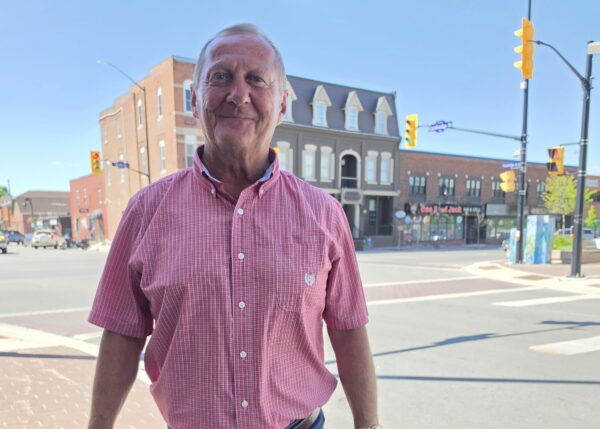
Charlie McDonald, councillor for Ward 7 in Lindsay, has officially launched his bid to become mayor of Kawartha Lakes.
McDonald, 70, has served on council since 2022, including two years as deputy mayor. He is a lifelong resident of Lindsay and is well known as the former owner of The Grand Hotel and Grand Experience Restaurant for more than a decade.

In a sit-down interview with Kawartha Lakes Weekly, the former deputy mayor said he is not releasing a full platform or promises at this time while he builds his campaign team and listens to citizens’ concerns.
But one document that will inform his thinking will be the evidence-based Vital Signs report created by the Kawartha Community Foundation – a comprehensive, in-depth report on our community’s wellbeing. The project, a partnership between the Kawartha Community Foundation and the Kawartha Works Community Co-operative, offers a new local way to assess the community and its key characteristics. Similar standardized measures have already been used in more than 80 municipalities across Canada.
McDonald’s background is deeply rooted in the city, having grown up on an acre of land across from the old Victoria Manor. One of six children, McDonald spent most of his days working on area farms. That’s one of the reasons he believes he will be a good mayor “for the whole city” he says, since he understands rural issues, too.
“I always made decisions on council that I felt was for the good of Kawartha Lakes as a whole – that was important to me,” he says, as opposed to thinking only about his own ward.
As deputy mayor of the city for two years in a row, he said he was pleased to work with all councillors around the table
A former chair of the Lindsay Downtown BIA, McDonald was also a superintendent at GM for 36 years, and an auxiliary OPP officer in both Peterborough and Lindsay for a decade.
These are experiences, he says, that teach one “how to work with everyone.”
The former deputy mayor says his approach will be to bring “common sense leadership” if elected mayor, and he will ask questions much the same way as a household owner would – “what do we need and what do we want?”
During his time as deputy mayor, McDonald championed the municipality’s Short-Term Rental program, pushed for a renoviction bylaw to protect stable housing, and served as the budget committee chair.
In a prepared statement McDonald says he has gained “valuable experience, built strong working relationships, and developed a deeper understanding of…the challenges and opportunities” facing the city.
Ward 6 Coun. Ron Ashmore has also declared his candidacy for mayor, along with Matthew Flynn.


The Rural-Urban Split Will Decide the Next Mayor
The entry of Ward 7 Councillor Charlie McDonald into the mayoral race officially sets up a classic Kawartha Lakes showdown. Ever since the provincially forced amalgamation of 2001, which welded 16 distinctly rural lower-tier townships and villages to the urban hub of Lindsay, our municipality has been locked in a quiet tug-of-war. Rural residents often feel their tax dollars vanish into Lindsay’s central bureaucracy, while urban taxpayers wonder why they are subsidizing thousands of kilometers of winding country roads.
The substantial and systematic removal of many Area Ratings of taxation, and the insistence of City staff that “we are one City,” does not make that rural/urban boundary and its inherent differences any less stark.
With Ward 7 Councillor McDonald and Ward 6 Councillor Ashmore now head-to-head, this structural friction will take center stage, and both are approaching the divide with entirely different playbooks.
Ashmore is running a classic rural-populist campaign, explicitly channeling the historic grievances of the outer townships. His signature promises—like “Road Complete 2030” and fighting the “big wall” of city hall bureaucracy—are tailor-made for rural voters who feel disconnected from centralized governance. Recognizing he cannot win on rural votes alone, however, Ashmore is trying to build an aggressive bridge into town by promising major urban economic victories, such as securing a Walmart and extending GO Transit to Lindsay.
McDonald, deeply rooted in Lindsay’s business community as the former owner of The Grand Hotel, represents the urban core. His policy history—regulating short-term rentals and backing a tenant-protecting renoviction bylaw—deals with the dense housing issues typical of growing urban settlement areas. To defuse the regional divide, McDonald is leaning into his personal biography, reminding voters he grew up working on area farms to prove he understands the whole city. Furthermore, by grounding his vision in the data of the Kawartha Community Foundation’s Vital Signs report, McDonald is making a savvy move to take regional bias out of the municipal budget entirely, reframing arguments around shared, objective community data which should appeal to urban and rural voters alike.
In a single-tier municipality like ours, the electoral math is brutalist. Lindsay is densely populated, but its urban vote is historically fragmented among multiple candidates—a reality underscored by the fact that there are already three registered candidates for mayor at this time. A highly motivated, unified rural turnout can easily sweep a candidate into the mayor’s chair.
But the math that matters most to the taxpayers of Kawartha Lakes isn’t just electoral; it is fiscal. This is why I continue to advocate for the reinstatement of Area Rating of taxation along the boundaries of the rural/urban divide.
To be clear, advocating for fiscal fairness is not a brilliant revelation unique to my own thinking. The term “Area Rating” is cited no fewer than 65 times in the original Victoria County Restructuring Commission report of February 2000. It was intended from day one to be the financial bedrock of an amalgamated city, ensuring people only paid for the service levels they actually received.
The outcome of this election will ultimately hinge on two questions: Can Ashmore convince rural voters that his aggressive infrastructure timelines around “Road Complete by 2030” are financially feasible without skyrocketing their property taxes? And can McDonald peel away enough rural support with his farming roots to protect his urban base?
The answer will determine the direction of Kawartha Lakes for the next four years. In the meantime, I would be pleased to see one or all of the mayoral candidates explicitly outline their platform around rural/urban fairness, and state clearly whether they would support Area Rating the roads budget and service levels along the rural/urban boundary. That represents fairness for both sides, and should appeal to both rural and urban voters alike.
Good for you, Charlie, for putting your name forth to support democracy in the mayor race. You’ll be glad you got that knee fixed with all the walking you’ll have to do this summer.
I have always supported you Charles.