
Analyzing 11 major indicators of community wellbeing through Vital Signs

The 2026 Canada Census is currently underway across the country. It will take about 18 months for the release of data collected this year to be available for public consumption and consideration.
However, for Kawartha Lakes, the most comprehensive, in-depth census of the community has already arrived. The 2026 Vital Signs community report on wellbeing promises to be an important portrait of the city for years to come.

The Kawartha Lakes Vital Signs report is the culmination of close to two years of information gathering, as well as an examination of the current important factors and challenges that determine decisions for the community at present and in the future. The project, the result of a partnership between the Kawartha Community Foundation and the Kawartha Works Community Co-operative, is a new approach locally to producing a scan of the community and its characteristics. However, the standardized means of measuring community wellness has been undertaken in more than 80 municipalities across Canada. The research program uses local knowledge to measure the vitality of a community and support action towards improving collective quality of life.
This report draws on publicly available data, local administrative sources, and community insights to offer a balanced and nonpartisan picture of wellbeing across Kawartha Lakes. The foundation and Kawartha Works consulted across the city with various subject matter experts or people with lived experiences. Interviews with dozens of city officials and representatives of many local service providers and not-for-profit organizations were conducted to garner data and important information, and to identify local current and future challenges for our community.
Completed earlier this year, the 2026 Vital Signs report has been met with overwhelming support, positive reaction and praise from members of the community and local organizations, as well as our municipal leaders. Chief Administrative Officer Ron Taylor calls partnering with the Community Foundation to implement Vital Signs a “game-changing” process.
“Through the 2024-2027 city strategic plan, we committed to measuring our efforts and reporting regularly on priorities and actions in the plan,” Taylor added. “The information produced…provides needed progress indicators profiling and comparing our quality of life in Kawartha Lakes,” he says.
The CAO says the data and information are critical to plan and execute city programs and services. It also shows where and how to best invest in response to local conditions, trends and demographics. Laurie Dillon-Schalk, outgoing Kawartha Community Foundation executive director, agrees.
“This is our report card on the community,” she told council earlier this year in presenting the findings. “It’s a beautiful combination of quantitative data and community consultation.”
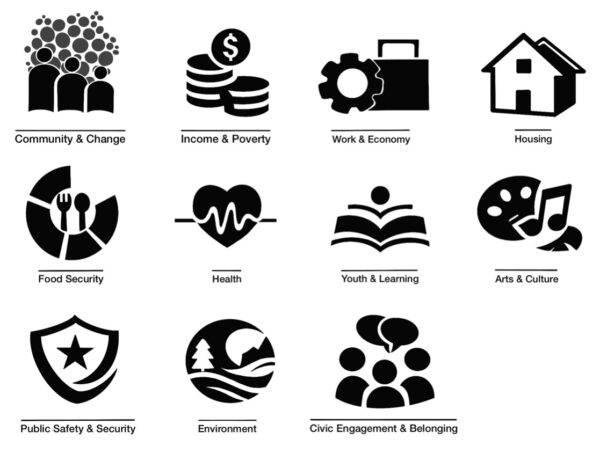
The Vital Signs report is comprised of 11 major indicators of community well- being. Collectively, the examination of the indicators has resulted in a valuable tool for strategic decision making.
“We are here to give our community the data on how we can improve lives, and we hope that we can be there to partner and invest in Kawartha Lakes,” Dillon-Schalk said.
Dillon-Schalk was quick to credit council and city management for its support of the project. In 2025, the city and the Kawartha Community Foundation entered into a partnership agreement that saw the municipality fund three components of the foundation’s activity, including the Vital Signs initiative.
“I’m very pleased that council voted to support the Community Foundation when it did, and I think that the numbers… show that the investment is paying off,” Mayor Doug Elmslie said upon the foundation’s extensive presentation to the committee of the whole. “It’s your stewardship of this project that made this possible. I think our whole community is beholden to you for what you’ve been able to do with the meagre funds that we offered to the foundation.”
Councillors were equally positive in their reception to the report. Deputy Mayor Tracy Richardson asked Dillon-Schalk for the “top three gaps” in service provision as identified by the report.
“Transportation, housing, and access to health care,” Dillon-Schalk said. “The challenge that we face is, a lot of this (information) uses census data from 2021. The good news is, we are in a census year, and the response rate from Kawartha Lakes residents has been higher than provincial averages in the past. This trend will hopefully continue and complement Vital Signs’ information for really understanding immigration, ethnicity and housing.”
Jim Armstrong, founder and past president of the Kawartha Works Community Co-operative (KWCC), agreed that the positive reception of the project is indication of a beneficial partnership between the municipality, the foundation and Kawartha Works. KWCC was established in 2015 to improve the social infrastructure in Kawartha Lakes by enabling the creation, development and management of not-for-profit initiatives with artistic, cultural, recreational, health, environmental, economic and social improvement aims.
“I’m really glad to see that on a broad basis at least, people seem to already know about Vital Signs,” Armstrong said.
In the last few weeks, the foundation and Kawartha Works have jointly presented the report to several not-for-profit organizations with a vested interest in providing services to local residents, and to partner with such groups to meet current and future service provision challenges. Longtime Lindsay resident Kathy Anderson attended the public “launch party” for the report earlier this year, and she sees opportunity and value in the work being done.
“I was impressed with the process that was undertaken, and I think the Community Foundation is in a good position to show solid data that shows our strengths, as well as our needs,” Anderson said.
Eric Smeaton was recently named the Kawartha Community Foundation’s new executive director, as Dillon-Schalk retires. He also sees great value in the report.
“It’s encouraging to see such a positive and thoughtful response from council and the CAO to the Vital Signs report. Having worked at the council table myself, I know how important it is to have reliable, community-driven data to inform decisions. This kind of alignment creates real opportunity for meaningful progress across Kawartha Lakes — and I’m excited about what we can build from here,” Smeaton said.
The foundation considers Vital Signs to be a “living document.” Following what are plans to initiate widespread community engagement to refine the analyses, identify shared priorities, and support initiatives for improvement this year, Vital Signs will be updated and revised as the community grows and evolves.
“In the years that follow, we intend to expand our indicators, deepen our data partnerships, and track progress over time so that Vital Signs becomes a lasting resource for the whole community” the report states.
“This vital information will greatly assist and inform other community partners and provide a better collective understanding of our community dynamics, strengths and vulnerabilities,” CAO Taylor added.
In the coming months, the Advocate will provide further information and analysis of each of the 11 indicators. Next month: an examination of the first indicator – the Community and How It Is Changing.
For more information on Vital Signs, or to read the full report visit kawarthafoundation.ca/vitalsigns.



Plugging Kawartha Lakes into the Regional Network
The recently released 2026 Kawartha Lakes Vital Signs report is more than just a collection of statistics; it is a masterclass in community self-reflection. The Kawartha Community Foundation and partners have provided our city with a vital “report card” that highlights exactly where we stand. It is an amazing piece of work that offers the data-driven foundation we need to move from conversation to action.
One of the most glaring “gaps” identified by the report is transportation. For many of us, the solution feels clear: we must bridge the gap between Lindsay Transit and our regional neighbors—Peterborough Transit and Durham Region Transit.
Imagine the transformation if a resident could board a bus in Lindsay and seamlessly connect to the Durham Region Transit (DRT) network, the Metrolinx corridor into the GTA, or the Peterborough Transit hub, connecting our 4 routes to Peterborugh’s 13 routes. Such a connection would be life-changing for seniors accessing specialized healthcare, students reaching campus, and newcomers seeking employment.
While it is true that a Lindsay-centric regional hub does not solve the immense transit challenges faced by much of rural Kawartha Lakes, it would create a massive “anchor” for the city in Lindsay. By making Lindsay a regional gateway, we enhance the value and utility of our existing local transit, making every stop within the city more relevant to the world outside it.
As a telecommunications and internet engineering manager (Fleming Grad ’90), I see this through the lens of a principle we learn early in our careers: The Network Effect.
In the world of technology, the Network Effect (often associated with Metcalfe’s Law) describes a phenomenon where a service becomes more valuable as more “nodes” are added to the system. Think of the Alexander Graham Bell’s first telephone: it was useless until a second person got one. The first telephone call was in 1876 with Bell saying “Mr. Watson — come here — I want to see you”. With every new person who joined the network, the value of your phone increases because you could call more people.
We see this today in how competing telecommunication companies interconnect their networks so your iPhone on Bell can call or text any other phone in the world, including those using competing Android devices on Rogers or Telus. The interconnection is what creates the value. There are 38 Million phones in Canada, and 8.31 Billion active mobile phones in the world – The network allows you to call all of them.
The same logic applies to our city. A transit system that only moves people within Lindsay, constrained by the political geography of the City of Kawartha Lakes, has a finite, localized value. But the moment you connect that “node” to the Durham or Peterborough “networks,” the value of our local system doesn’t just grow—it multiplies. We aren’t just adding a bus route; we are plugging Kawartha Lakes into a massive social and economic grid that extends across the province, Canada and via Pearson airport to the world.
The Vital Signs report has given us the diagnostic and the “business case”; now it is time for the infrastructure. And there is a funding solution ready for us. The Ontario government is heavily investing in transportation, including via the Ontario Transit Investment Fund (OTIF), which was recently doubled to $30 million to help rural communities like ours start or expand transit.
Other regions are already proving this works. Grey County received nearly $9.5 million for regional network integration, and Middlesex County received over $3.4 million to connect four intercommunity routes to London.
Selwyn Township “The Link” is a rural public transit service, established in 2021, and that serves as a real-world example of the “Network Effect”. Selwyn partnered with the City of Peterborough to operate two bus routes connecting Bridgenorth, Lakefield and Curve Lake First Nations to the larger Peterborough Transit network, via the Trent Univerity Transit Center allowing Selwyn residents to access a much broader social and economic grid. Selwyn, with a population of 20,000 and every bit as rural as Kawartha Lakes, has already solved this and have just extended the contract with Peterborough Transit to continue the service to April 2027. (It costs Selwyn $90 an hour to have Peterborugh Transit provide the regional bus with driver and fuel.)
By connecting our networks, we allow our residents to “self-help” their way to a better quality of life. Let’s add Kawartha Lakes to the list of OTIF grant recipients, connect our nodes, and get on the bus.
Here’s the announcement where the Ontario Government doubled the OTIF funding pool.
https://news.ontario.ca/en/release/1007240/ontario-doubling-funding-to-help-smaller-communities-build-safe-and-reliable-transit
Well said, Randy, and hear hear!!