Say cheese! A snapshot of local photography studios
As I write this, I am looking up at a professional photographer’s hand-tinted portrait of my late paternal grandmother, who would have turned 100 years old this month. Jane Sheila Drynan McLuckie – who would add McKechnie to her name upon marrying my late grandfather in 1949, and Bebbington after remarrying following my grandfather’s death in 1998 – was born on May 31, 1926, the only child of James and Jane McLuckie. Her doting parents took innumerable pictures of her throughout her childhood, while other shots were captured in photographer’s studios. That hanging on the wall was taken in the Lafayette photography firm’s Glasgow studio at some point in the 1930s.
Professional photography studios were once a fixture in communities like Fenelon Falls and Lindsay, a tradition that lasted almost to the turn of the 21st century. The proliferation of digital photography has largely rendered obsolete the darkrooms of old and photographer’s studios complete with sometimes exotic-looking hand-painted backdrops now seem gaudy and quaint. And yet it was thanks to these businesses that we can now treasure for posterity the likenesses of those who went before us.
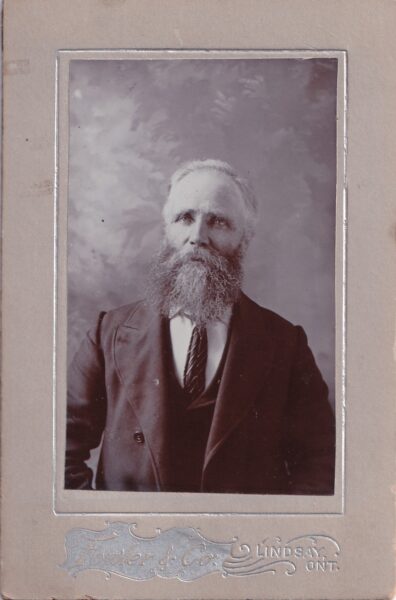
Photography had been steadily evolving over the course of the 19th century. Many inventions were being developed on both sides of the Atlantic that would in time be leveraged by local photographers like Hamilton Fowler, who began his career in Fenelon Falls in the 1870s. After spending close to four years capturing Fenelon residents on camera, Fowler shifted his attention to Lindsay, where he went into a partnership with Isaac H. Oliver and worked with him until about 1887. (Fowler remained in business well into the new century, specializing in among other things wedding photography. He later retired to Toronto, where he died in 1924.)
Their collective output was enormous; a glance through the collections of vintage photographs maintained by local museums (or enclosed in albums passed down through families who have lived in the area for three or four generations) will reveal many a family portrait with provenance in the studios of Mr. Fowler or Mr. Oliver; the latter maintaining for several years a studio in the building directly across from St. Andrew’s Presbyterian Church in Lindsay.
In looking closely at these pictures, one will see several props and hand-decorated backdrops used in turn-of-the-century photography studios. These might well have added a slice of life to what was otherwise a serious business – literally speaking. Long exposure times meant that subjects could scarcely maintain a smile for any duration, and the Victorian formality of the period also demanded that frivolity in expression be kept to an absolute minimum. (“A photograph is a most important document,” wrote American humourist Mark Twain, “and there is nothing more damning to go down to posterity than a silly, foolish smile caught and fixed forever.”)
By 1900, families desiring to have their picture taken could travel into Lindsay and sit for Messrs. Fowler or Oliver, or they could venture into Fenelon Falls where James Stanton had established a thriving business on Colborne Street in 1896. Within 30 years, Stanton had become synonymous with professional photography in his adopted village. “Today the studio has all the equipment of a modern amateur finishing department and is one of the best equipped studios in both portrait and amateur work outside the cities,” declared the Fenelon Falls Gazette in 1928.
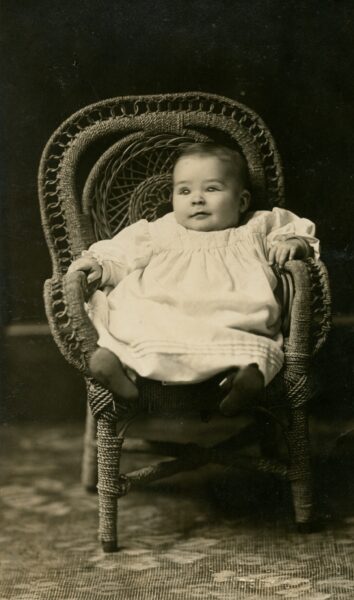
Back in Lindsay, the local photography market had by the end of the First World War become dominated by the Morton Studio. Born in 1872, Maud M. Morton had established one of the most lucrative studios in the community by the time she was in her thirties. Taking advantage of limited advertising space in the local press, Miss Morton urged her customers to stop by her Kent Street studio where they could have 5” x 8” or 8” x 10” enlargements made for free with every $2 to $4, respectively, of “amateur work” (that is, pictures developed from film in personal cameras). Morton Studios also specialized in “Charming Child Studies,” with parents being encouraged to “bring the children along and have not merely ordinary portraits taken but artistic pictures made of them.”
Maud Morton’s business was acquired in the autumn of 1922 by Fulton C. Stewart, who had worked under Miss Morton starting in 1912. Under his leadership, the studio carried on a reputation for what the Lindsay Daily Post in 1924 called “a high-grade class of photography, superior to the work of city studios.” Twenty years later, he was joined by Stanley B. Bright, who would subsequently acquire the Morton-Stewart assets in 1952 and rechristen the business as Bright’s Studio and Gift Shop.
By the late 1950s, Lindsay was served by a handful of professional photographers, of which George Dent was perhaps the most prolific. Dent would eventually go into the real estate business, and within 15 years the local photography scene would become equated with John Boyd. A professional photographer who had worked at Panda & Associates in Toronto, Boyd worked with Robert Payne, also a professional photographer, to establish Kenlin Studios (a portmanteau of “Kent” and “Lindsay”) in 1958. Together, they would carry forth the traditions of Fowler, Oliver, Morton, and other photographers in capturing Kodak moments for a new generation of local families.