

Resident concerned about roadside brushing
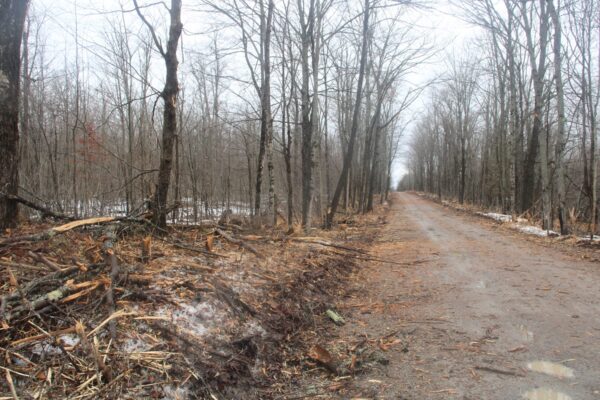
The city is carrying out roadside brushing along Schell Line to improve visibility and reduce damage to maintenance equipment, but a local resident says the work is excessive and raises concerns about its environmental impact.
Gretchen Mehegan owns land that spans more than a kilometre along Schell Line, which runs north-south between Burys Green Road and Somerville 3rd Concession, about 10 kilometres north of Bobcaygeon town centre.

In an email to the Advocate, she said the road sees little traffic, with most users being local farmers, along with dog walkers, ATVers and seniors driving through to view wildlife.
She criticized the extent of the clearing work.
“For some unknown reason, the city works department has felt it necessary to widen the road – which is wide enough to easily accommodate the city snow plows,” Mehegan said. “But apparently the road needs to be widened. So they set about clearing away smaller trees. … Limbs are torn from trees leaving gaping wounds of raw wood. All is left as it is – apparently with the view that over time nature will heal itself. In the meantime, ugliness reigns.”
However, Chris Porter, Kawartha Lakes’ manager of road operations, said the city is not widening Schell Line and has no plans to do so.
“The intent of the work being carried out here was primarily to reduce equipment damage from contact with brush, improve sightline and to increase sunlight exposure on the road,” he said.
Porter added that when the city undertakes these projects there’s a focus on the environment’s well being. The chief piece of legislation the city uses for guidance when brushing is the Migratory Birds Act, he said.
Porter said the city completes most of the required roadside brushing in early spring or autumn to ensure the projects are compliant with the act and not interfering with nesting periods.
“Where emergent work is required during nesting season, the city will engage a biologist to complete a nesting sweep prior to operations proceeding,” Porter said. “This is an additional cost to the general operation, and has a time period limitation, so it is typically only used in the case of very time-sensitive work, such as the removal of a safety hazard.”
Still, Mehegan said the project could result in the removal of between 20 and 60 trees and is leaving the landscape unattractive.
“Why would the city works department want to take down 20 to 60 healthy trees that are obstructing absolutely nothing along a dead-end road?” she said. “Why would we want to remove trees in light of the climate crisis?”
Porter said areas affected by brushing can appear “unsightly” immediately after work is completed, but he added that vegetation typically regrows over time.
“Due to the volume of brushing work and speed at which regrowth occurs, the city typically only brushes a road once every 10 to 15 years, so when completing the operation on a given road, staff will go to a sufficient width to achieve the intended benefits,” he said.

It seems the response from the City of Kawartha Lakes is reasonable, citing safety and other concerns. Nature will fill in the gaps soon enough.We shan’t be going around shutting down necessary maintenance because of a subjective view that we are in a “climate crisis”.
“Climate crisis” is not the crux of the argument. In N CKL where we are we had quite the disagreement esp.around 5 yr ago – ongoing but no longer expressed for the futility in trying to get through to some people… – about massive completely unjustified tree removals along our dirt rd and the way the yearly slashings and manglings have been done. Turns out there is ZERO guidance from the province as to how to deal with roadside vegetation, and all you get despite evidence to the contrary re what they do is that they’ll continue to do what they always have been doing. The mentality is evidenced well in what one engineer told me there, up to him all would be clear cut. Trees are marked for removal completely arbitrarily. Trees are mindlessly slashed, which can lead to entry of disease and thus requirement for more labour (make-work policy eh? all the while claiming cost saving). Resultant careless uglinees is an issue but is not the main pt either. There is an obsession with opening the canopy over roads, but at least on dirt roads this can be misplaced for winter especially. And on various paved roads in area municipalities we see lovely canopies that are tolerated to no apparent harm to the roads. Trees by roadsides also serve to calm traffic, can actually help remove lots of possibly destabilizing water from understructure of roads. Trees are marked for removal for ZERO good reason and trees needing removal are skipped over. On and on I could go on this topic we researched to contest the active policy. Our councillor despite repeated emailing notifications from multiple residents on the issue in our area went totally & uselessly mum. Supervisor, engineer, all the way down completely uninterested…EXCEPT in one case the actual foreman of the crew hired to do the job responded correctly to our plaint about one particular tree which got this all started, and convinced whomever on the spot to save the grand old tree. And if that one was saved close as it was to the overgraded and needlessly overwidened road, virtually none of the other removals were justified…But how to get through and change any attitude when the regnant one is for “roads, roads, roads” even when roadways are harmed?