

Local resident urges council to oppose high speed rail project
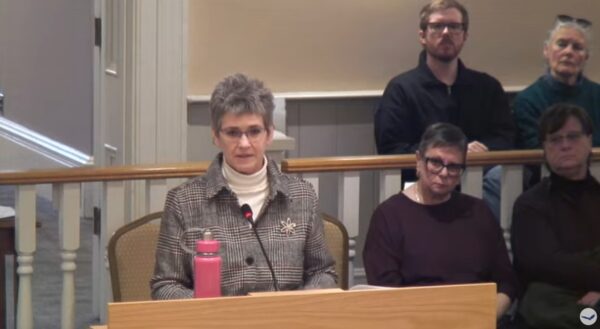
A resident of the rural south end of Kawartha Lakes is urging council to formally oppose the proposed Alto high-speed rail line in its current form, warning the project, as it stands, could create barriers for communities, strain municipal services, negatively impact the environment and saddle local taxpayers with long-term costs.
In a deputation during the April 7 committee of the whole meeting, Laurie Reynolds asked council to join several other municipalities along the proposed 1,000-kilometre HSR corridor between Toronto and Quebec City in opposing the project in its current form.

Reynolds said that a high-speed rail line with no land crossings, as is proposed, will sever existing roads, leading to longer travel times and problems for emergency services, snow removal and waste collection.
“Communities will become divided,” Reynolds told council. “Many families have deliberately chosen the countryside to preserve nature and live in peace, but a 300 km/h train will wreak havoc on this, and it offers no meaningful benefits to our residents and comes with significant and long-lasting harm.”
Reynolds also cautioned that logistics costs for the project will be offloaded onto the municipalities across the areas being targeted for the line’s route.
“There will be a long-term operating burden for the City of Kawartha Lakes resulting from this (high-speed rail) line, and this will require the city to increase property taxes for all residents,” she said. “Communities such as ours should not be left to absorb the long-term effects of this project which does not serve our community.”
Reynolds added that she is supportive of improving transportation infrastructure in Ontario and Canada, but said such improvements should not negatively impact rural communities. She said high-frequency passenger rail along existing lines should be considered instead.
“Residents need affordable, daily transit that serves the communities through which it runs, and this should be done by upgrading systems along already existing corridors,” she said.
In February 2025, then–prime minister Justin Trudeau announced plans to build an electric high-speed rail network between Toronto and Quebec City, aimed at reducing travel times and increasing connectivity in Canada’s most populous corridor.
The exact path the line will take from Toronto to Quebec City – which includes stops in Peterborough, Ottawa, Montreal, Laval and Trois-Rivières – has not yet been finalized. Alto, the Crown corporation building the line, has said it expects to decide by the end of 2026.
During the meeting Deputy Mayor and Ward 8 Coun. Tracy Richardson sponsored a memorandum opposing the project in its current form, requesting council receive the memorandum at the next regular meeting and forward the resolution to the offices of Prime Minister Mark Carney, Transport Minister Steven MacKinnon and Haliburton-Kawartha Lakes MP Jamie Schmale.
The memorandum mirrors concerns expressed by the Eastern Ontario Wardens’ Caucus about eastern Ontario having only one stop on the proposed line and that the project benefits cities with stations on the line at the expense of rural communities in between.
The memorandum also requests Alto provide additional in-person consultations for Kawartha Lakes residents before making further decisions related to the project.
Speaking to the memorandum, Richardson thanked Reynolds, whose family farm is in Ward 8, for her presentation.
“You really did allow us to feel how the residents and the agricultural community are feeling,” Richardson said.
Richardson said there are too many unknown variables related to the HSR project.
“The Alto proposal, as it stands, risks leaving rural communities like ours behind, offering limited benefit while placing real strains on our residents, our agricultural land, environment and infrastructure,” she said. “We’re not opposing progress here today; we’re calling for fairness.”
Ward 5 Coun. Mark Doble told council he supported the memorandum, adding the city would be better served by restored VIA Rail service as well as improved bus service from the city to Toronto.
“Council should formally oppose the Alto project in its current form,” he said. “There needs to be more consultation … and the government needs to be prepared to radically revise this plan.”
The high-speed rail project has also received criticism from the federal Opposition recently. Conservative Leader Pierre Poilievre has called for Carney’s government to cancel the project, characterizing it as a “$90-billion Liberal boondoggle” at a March 31 press conference in Peterborough.
The total cost of the project is estimated by Alto CEO Martin Imbleau to be between $60 billion and $90 billion.



The Alto HSR Project: An Infrastructure Reality Check
Regrettably, the Alto High-Speed Rail (HSR) project has devolved into a polarized battle: Rural vs. Urban and Conservative vs. Liberal.
In the heat of this political friction, several critical engineering and economic realities are being overlooked. Unless you are a transportation engineer, it is easy to miss the physical constraints that dictate the physical ralityo of this project. To understand why Alto is being built the way it is, we have to look at the math:
The Physics of Speed:
Alto HSR cannot simply run down the median of Highway 401. The 401 was designed for 120 km/h traffic with curves spanning a 600–900 meter radius. At 300 km/h, a train would derail on those same corners. High-speed rail requires sweeping curves of 4,000 to 7,000 meters for safety and passenger comfort.
The Freight Conflict:
We cannot simply “improve” VIA Rail on existing tracks. CN Rail owns those lines and prioritizes freight—the backbone of Canada’s export economy. Passenger rail will never be reliable so long as it remains a guest on a freight line.
The Infrastructure Cost:
Bridges and overpasses are the most expensive part of rail construction. A “Lakeshore” route through Oshawa, Cobourg, and Kingston would require hundreds of elevated structures to maintain grade separation in densely populated areas. A northern rural route, while controversial, is the only way to make the project economically feasible by reducing the sheer number of required bridges.
The Business Case: Rail vs. Air
Slowing the train to 120 km/h or adding dozens of local stops would kill the business case entirely. Alto is designed to compete with air travel. While a jet flies at 800 km/h, the “downtown-to-downtown” time for a short trip like Toronto to Ottawa is ruined by airport commutes and security lines. On a cross-country flight to Vancouver, the airport hassle is a small fraction of the trip; on a “Golden Triangle” flight (Toronto, Ottawa, Montreal), it’s the majority. This is where HSR wins.
The Environmental Mandate
By utilizing Ontario and Quebec’s clean nuclear and hydro grids, Alto will be nearly carbon-free. Short-haul flights are Canada’s most carbon-intensive transit due to the “takeoff penalty”—the massive fuel surge required to reach altitude.
Air Travel: 123g–150g of CO_2 per passenger-km.
Electric HSR: Theoretically near zero operational emissions.
The Political Divide: Who are we aligning with?
Before Kawartha Lakes residents join the opposition, we must look at who is leading the fight. The Eastern Ontario Wardens’ Caucus (EOWC) represents 1.1 million rural residents, but it explicitly excludes the major hubs of Ottawa, Kingston, Belleville, and Peterborough. In fact, Lindsay—with 25,000 people—is one of the largest urban centers the EOWC represents. The urban interests of Lindsay are not well represented by EOWC lobbying and interests.
Kawartha Lakes sits at a crossroads. We are part of the Greater Golden Horseshoe, serving as a bedroom and retirement community for the GTA. Yet, our leaders are aligning us with rural farming counties to the east via the EOWC.
Our neighbors in Clarington (population 105,000) sit with the Ontario Big City Mayors, and Scugog and Brock align with the GTHA Mayors and Chairs. Those groups are lobbying for Go Expansion and regional transit, housing solutions, a new financial deal for growing cities—the very things that southern Kawartha Lakes and Lindsay needs to thrive.
While the urban centers stand to gain a world-class transit link with Alto, the rural “gaps” are being asked to host a 300 km/h wall that severs roads and divides farms. (Which already exists with the CP Havelock rail line in any case) We must decide if we want to be a “gap” that says no to everything, or a growing municipality that demands a seat at the urban table.
A Choice of Identity
Kawartha Lakes has a choice to make. Are we truly aligned with the needs of small rural counties in Eastern Ontario? Or are we a part of the GTA that needs to address regional transit to Toronto, growth development, healthcare and housing?
We cannot protest the environmental effects of a new natural gas line to Bobcaygeon one year, and then flip around the next to reject an electrified train that would substantially reduce our carbon footprint from short haul air travel.
While Kawartha Lakes will not have an Alto HSR station, it’s 45 minutes to Peterborough which will have one. That’s a heck of a lot closer that a trip to Pearson Airport, and it opens up Lindsay and southern Kawartha Lakes to easier travel to Ottawa and Montreal.
There is also a hidden opportunity with Alto Rail crossing southern Kawartha Lakes and Durham Region. We need to encourage the Ontario Government to partner with the Federal Government to integrate Metrolinx/Go Transit service with Alto. Regional transit from Lindsay to Peterborough. Potentially a Go Train that runs along the same right of way as Alto, but offers more frequency stops that serve the region.
It is time for Kawartha Lakes to decide how we lobby the Province. Are we a small rural Eastern Ontario County, or are we part of the GTA? I think we’re with the wrong lobby group. Kawartha Lakes’ needs are not the same as a rural county south of Ottawa.
Lindsay isn’t “just” alinging themselves with the gap south of Ottawa!
Which, isn’t a gap, it’s filled with farms, environmentally sensitive areas and very real people!
Regardless of either of the proposed corridors under study.
This proposed project at the cost of billions (without a final estimate, according to ceo Imbleau) will be born by every Canadian, devastating thousands of farmlands (again, according to Imbleau) as well as environmentally sensitive areas…
The points raised above of locally raised taxes, dead end rds, exporiation is not a worthy argument of ongoing costs to min benefits!
Wherein, other scenarios exists that services more at less costs, slightly slower speeds and zero exporiation!
Furthermore, the company alto is working with has an extremely poor past record that frankly, I’m unsure how re naming it changes anything!?
Inability of finishing projects, finishing projects correctly, misappropriation of funds, bribery…
On multiple projects!
This entire project, lack of transparency and push through via c15 leaves significantly more questions than answers!
Nevermind Imbleau depicting those opposed to the proposed project in either corridor and how he protrays them in the media!
How do you propose under/over passes will be paid for within kawartha lakes?
Once lands are severed and rds are dead ended?
California HSR isn’t nearly complete, has far exceeded costs and run on for years past expected deadlines!
Furthermore, which HSR is currently running solely at a profit!? Without any government subsidies?
I’d also be interested, in tourism within those places, length of HSR vs population density vs stops.
As it stands, many companies are capable of running online meetings when necessary. Students move to cities wherein they attend schools and other less expensive and destructive alternatives exists in order to move people…
The HSR, by design is only for a fraction of ridership at a significant cost to the entirety of Canada!
Lindsay’s and Peterborough’s transportation needs have been neglected for decades. I go to 3rd world countries with much better transportation services. And now their answer is to create a high speed rail at a cost of billions to service the wealthy and business class. You gotta love it.
In response to the poster above:
Your comment: “Furthermore, the company alto is working with has an extremely poor past record that frankly, I’m unsure how re naming it changes anything!? Inability of finishing projects, finishing projects correctly, misappropriation of funds, bribery… On multiple projects!”
Alto is a Crown Corporation. It was first established March 2022 as VIA HFR – VIA TGF Inc. and on February 19, 2025 Trudeau announced that the project would be upgraded from “High Frequency” to true High-Speed Rail (speeds up to 300 km/h). As part of this pivot, the corporation was rebranded as Alto.
The company Alto is working with is Cadence. A private-sector consortium selected by the Government of Canada to design, build, finance, operate, and maintain the Alto high-speed rail (HSR) network. While Alto is the crown corporation overseeing the project, Cadence is the “team of experts” doing the heavy lifting on the ground.
Who is in the Cadence Consortium?
The group is a powerhouse of Canadian and international companies, specifically chosen for their experience with massive rail projects:
CDPQ Infra: The infrastructure arm of Quebec’s pension fund (the group behind Montreal’s REM).
AtkinsRéalis: Formerly SNC-Lavalin, a major Canadian engineering and project management firm.
SYSTRA & SNCF Voyageurs: French rail giants with world-class expertise in high-speed rail (TGV).
Keolis: A global leader in operating public transport systems.
Air Canada: Joined the group to help integrate rail with air travel, potentially allowing for seamless “train-to-plane” ticketing.
What is their role?
Cadence isn’t just a contractor; they are a co-development partner. Their responsibilities include:
Design & Route: Working with Alto to decide exactly where the 1,000 km of track will go (connecting Toronto, Ottawa, Montreal, and Quebec City).
Financing: Helping to secure the massive private investment needed for the project, which is estimated to cost between $60 billion and $90 billion.
Operations: Once the trains are running (at speeds up to 300 km/h), Cadence will likely be the entity actually managing the day-to-day service, not VIA Rail.
Integration: They are tasked with taking over VIA Rail’s current “Corridor” operations and blending them into the new high-speed system.
I think what the poster above was trying to complain about is SNC Lavalin, now known as Atkin Realis.
The SNC-Lavalin scandal (“SNC-Lavalin Affair”) was a major political crisis in 2019 involving Prime Minister Justin Trudeau, his office, and allegations of improper interference in the Canadian justice system.
SNC-Lavalin was facing criminal charges for allegedly paying roughly $48 million in bribes to Libyan officials under the Muammar Gaddafi regime to secure government contracts. If convicted, the company would have been barred from bidding on Canadian federal contracts for 10 years—a move that could have bankrupt the firm or forced it out of Canada.
The scandal broke when reports emerged that the Prime Minister’s Office (PMO) had pressured then-Attorney General and Justice Minister Jody Wilson-Raybould to intervene and grant the company a Deferred Prosecution Agreement (DPA)—essentially a “get out of jail for a fine” deal—rather than pursuing a criminal trial.
In December 2019, the construction division of SNC-Lavalin pleaded guilty to one count of fraud, paid a $280 million fine, and was placed on three years of probation, avoiding the catastrophic 10-year ban on federal bidding.
So yes, SNC Lavalin, now known as Atkins Realis is a black eye for this project, and yes, Justin Trudeau remains unpopular.
But it doesnt mean that the merits of High Speed Rail are any less beneficial.
Complaining about Atkins Realis being part of Cadence is largely a Conservative talking point used to take political swipes at a project that is intended to create 50,000 jobs and reinvest in infrastrcuture to power the Ontario and Qeubec economy forward.
To Recap, the Goals and Benefits of Alto are:
Speed & Frequency: To achieve cruising speeds of 300 km/h or more on approximately 1,000 km of dedicated, electrified tracks. This aims to cut travel times in half—for example, making the Toronto-to-Montreal trip competitive with flying.
Reliability: By building tracks separate from freight trains (which currently cause the majority of VIA Rail delays), the goal is to achieve near-perfect on-time performance.
Decarbonization: To provide a low-emission alternative to cars and short-haul flights, significantly reducing the carbon footprint of Canada’s most populated region. (There are hundreds of short haul flights daily between Toronto, Ottawa and Montreal)
Nation Building: To connect major hubs (Toronto, Peterborough, Ottawa, Montreal, Trois-Rivières, and Quebec City) into a single integrated “mega-region” to boost national productivity.
Projected Outcomes
Economic Impact: The government estimates the project could add roughly $24.5 billion annually to Canada’s GDP once fully operational.
Social Connectivity: Improved access to affordable housing and jobs by allowing people to live in one city and easily commute to another (e.g., Peterborough to Toronto or Trois-Rivières to Montreal).
Freight Capacity: By moving passenger trains to their own tracks, the project frees up existing lines for freight, improving the movement of goods across the country.
Timeline: While the project is currently in the “co-development” phase (field studies and route finalization), construction is expected to begin in segments, with the Ottawa–Montreal leg likely being the first priority.
Current Challenges
Despite these goals, the project faces significant hurdles as of 2026:
Cost: Estimates have ballooned to between $60 billion and $90 billion, leading to debates over taxpayer value.
Land Use: Many rural communities and farmers along the proposed “northern route” (through Peterborough) are concerned about land expropriation and environmental damage to sensitive areas like the Frontenac Arch.
Sad to see so many people against the high-speed rail.
I have been unable to get medical treatment for my current vision problems simply because I had no way to get to Toronto at a reasonable price – Community Care drivers cost a couple of hundred dollars per trip – even more now with the current oil crisis – buses do not run here daily, and I simply could not afford the many trips I would have needed as a senior on a pension. There are no local doctors with the expertise for my particular problem, and I couldn’t drive myself nor do I have anyone who I could ask to drive me. So I live with this problem and have to curtail many things because I cannot get treatment.
So many countries have proven that public rail systems are a boon to the countries. Yes, there are disadvantages, but how much damage do cars and the road systems do to those same areas? Yes, we need to protect sensitive areas. But looking at travel anywhere in Europe and Asia and you can travel quickly and easily anywhere for a reasonable price. I commuted in my car in the winter, an average of 200 km per day, travelling to the Toronto area as far as Mississauga – from Bobcaygeon! – for some contracts, from Lindsay because I could not find a job in this area that would pay enough to keep my rent and utilities, nor could I, as a single person, earn enough to live in Toronto either.
I do not understand the determined anti-rail bias that North Americans have for decent rail systems. It’s a mindset that is, from my viewpoint, pure resentment against having their nice little villages disturbed, while people who need those systems are ignored. Tourists are coming here in cars anyway, I doubt very much that rail would impact those numbers, and it would benefit many who could get jobs closer to Toronto and live here.