Lingering in Lifford
Nearly 30 years ago, my cousin, Alex, and I were visiting our aunt and uncle’s farm just north of Bethany when our imaginations went into overdrive. As we explored that 200-acre property, we got it into our heads that a thriving community had once existed where we now walked. Overgrown lanes linking the various fields became streets. A weather-beaten barn became a saloon worthy of a Hollywood western. Gullies in the bush might have been mine tunnels.
An entire history grew up around our hypotheses. We ultimately concluded that the wealthy magnates who once populated this “town” had moved on to greener pastures, leaving the townsite to rot and ultimately be consumed by a massive conflagration in the mid-19th century. This – conveniently – eliminated any trace of a community that, after all, only existed in our imaginations.

But although our aunt and uncle’s farm was never the site of the boom-town streetscapes and Antebellum-style mansions my cousin and I concocted in our play, this part of our municipality was home to a handful of tiny hamlets that have largely disappeared from the landscape. To the north was Fleetwood, which was profiled in the August 2020 issue of the Advocate. East of that was a little place called Franklin. Not far from the farm was a railway siding called Brunswick, which in the latter part of the 1800s boasted a hotel, post office, and sawmill.
And up the steep hill west of the farm, on what for years was called “the 10th line of Manvers,” was the hamlet of Lif- ford – my destination on a very warm Friday in early June.
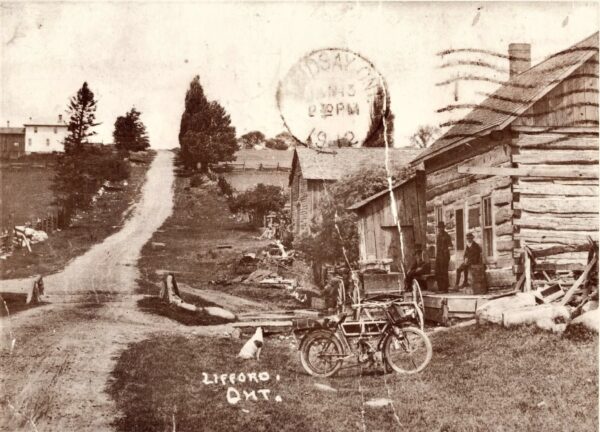
Contemporary maps suggest that Lifford proper was concentrated a few lots east of what is now Highway 35 South – but for all practical purposes, its cultural core was clustered around a church and school situated between Beers Road and St. Mary’s Road. And it’s here that I arrive not quite an hour and a half after leaving Lindsay. Tethering my bicycle to the gate of St. Mary’s Cemetery, I take a brief walk west along the roadside in the direction of S.S. No. 5 Manvers. Built about 1901, it is now a private home enjoying a commanding view of the surrounding countryside.
And the view is spectacular, though I certainly don’t envy the farmers who once had to coax their horses and wagons up and down the hilly terrain hereabouts. Ubiquitous page-wire fencing peeks out from behind some tired-looking lilac shrubs and cedar trees; a row of boulders surrounded by brush calls to mind an older method of defining property lines. A few farmhouses remain in situ between Highway 35 and St. Mary’s Road. Long gone, though, are the blacksmith shops, general stores, hotels, and assorted craftspeople who plied their trades along this quiet rural thoroughfare.
Lifford’s commercial district may be a thing of the past. Its cemetery, however, is still very much active. Here, beneath towering stands of deciduous and evergreen trees, lie the remains of people who made their mark on this hamlet – and indeed, Manvers Township more broadly. McGill. Preston. Sisson. Staples. These names dominate many of the headstones, ancient and modern. (One of them, the late Robert Sisson, was the oldest man in Ontario when he died in 2021, aged 107.)
From a distance, the picturesque church towering over the cemetery looks like a bona fide relic of the 19th century – but appearances can be deceiving. St. Mary’s Anglican Church (so named for Mary Preston, an early settler), was originally built in 1852. Consumed by fire on Ash Wednesday of 1993, it was subsequently reconstructed using traditional materials – albeit on a smaller scale.
“The chapel was designed to reflect the wishes of the committee members to reflect the character of the original building, even if it could not be a true copy of the original,” says Ron Awde, the architect who supervised the project. “Many of the members of the church most interested in the reconstruction were the grandchildren of the original settlers in the area who founded and built the church in Lifford and had been lifelong parishoners.” The new building was dedicated in 1997.
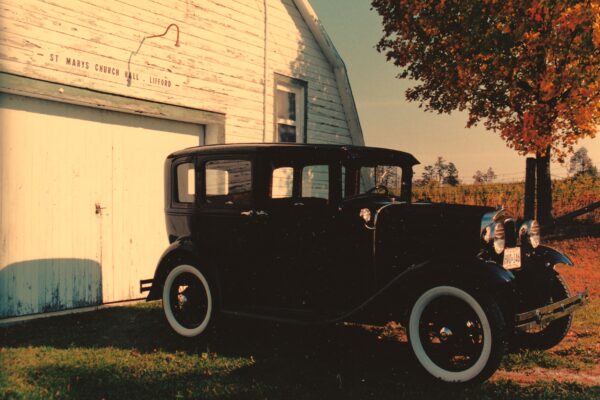
The sun is beating down on the cemetery as I make my way across the road, where in the shade of the parish hall I partake of my luncheon: ham and roast beef sandwiches, carrot sticks, blueberry muffins, ginger ale, root beer, and a couple of apples – plus an enormous bottle of water. Built in 1936 using funds raised by the Women’s Guild of St. Mary’s Church, this barn-like hall once played host to such events as salad suppers and the annual garden party.
“The well-laden tables were attractively displayed by the members of the Ladies’ Guild and others,” noted the Lindsay Daily Post on July 8, 1953, following one such party. “These were emptied by the large throng of hungry visitors, but were refilled again with more of the same.” Today, the hall and surrounding lawn are silent.
Lifford may not have been as grand as the fictitious town my cousin and I fashioned in our imaginations all those years ago at our aunt and uncle’s farm down the road. Nevertheless, it retains a peaceable charm that makes this corner of Kawartha Lakes most memorable.