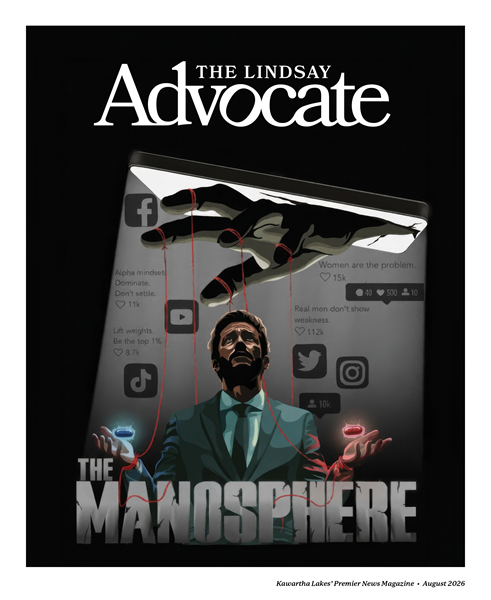
Inside the manosphere
How online misogyny is shaping young minds

Colsyn Wylie was mopping the floor at her paid job at Kindred in Lindsay — work she does to help pay for university — when an older female customer told her it was good practice for becoming a housewife.
It was a passing comment, but it carried the same message young women say they are hearing more often online and in person: that a woman’s place is still supposed to be in service to men.

While it doesn’t usually come from older women, as in Wylie’s case, it’s an echo of what young men are absorbing online in what is broadly known as the manosphere. This is a loose network of influencers, podcasts and online communities built around hyper-masculinity, resentment toward women and a promise to teach men how to win back power they believe they have lost.
Influencers with millions of followers are trying to give other men the ‘cheat code’ to win at life. They try to show them it’s important to have access to high levels of power. Oftentimes, these men can be seen showing off their physique (also referred to as looksmaxxing), talking about investing, and showing off their wives – who often are stay-at-home moms who also take care of household chores. Many of these men also practice what is called one-sided monogamy; their partner is expected to be monogamous, but they’re allowed to have multiple partners.
Wylie, 19, says this behaviour is something she’s often seen online. The Kawartha Lakes resident says the most prominent platform for these content creators is TikTok.
“I feel like the influencers who are spreading this message are saying (to men) if you want to move up in the world and you want to have money, you need to have people, who are women, working for you and doing these things for you, so you can focus on your career and your investments. And when you come home, everything’s taken care of for you.”
Many of these men say things that has Wylie having to double check if they’re being serious. “In my own head, I feel like I’m telling myself that there’s no way that could actually be how these men are viewing me as a woman, but then you see men in real life, and you’re like, wait, this is actually how they choose to conduct themselves.”
Perhaps the most infamous figure associated with this world is Andrew Tate, who built an online empire around female subjugation and hyper-masculinity. His central message to followers is that men have been weakened by
feminism and by a society he portrays as stacked against them. (At press time Tate and his brother, Tristan Tate, were arrested in the U.S., accused of rape and sex trafficking. They are fighting extradition to the United Kingdom.)

Andrew Tate founded an online network called The War Room, which costs users $8,000 per year, based on the mantra “free the modern man from socially induced incarceration.” There men have access to classes to help shape them into being the ideal man.
While Wylie hasn’t seen too much of this extreme behaviour in person, there was the mopping incident and a regular stream of male customers telling her she should smile more.
Sage Stapleton said she was around 10 when she faced misogyny. “I remember the first time I ever got called something misogynistic was in fifth grade. I don’t even think the kid even knew what the word was, and how can you be a slut in Grade 5?”
Stapleton, also a Kawartha Lakes resident, didn’t know what the word meant, but she knew it was being used as an insult.
She volunteered at a summer camp a few summers ago and had one six-year-old boy consistently say things like ‘girls can’t run as fast, girls aren’t as smart,’ and she had to explain to him why that wasn’t okay to say. While this isn’t the extreme behaviour that is seen online, it’s evident that misogynistic behaviour is still seen in society.
Wylie said there’s nothing wrong with wanting to be a wife and a mom who stays at home. “(But) you don’t need to be pushing that onto other women who want to do more,” she says of other women who try to influence this thinking.
This is known as a “tradwife” online. They make the life of a stay-at-home mom seem glamorous and essentially turn it into an aesthetic that all women should want. Yesteryear by Caro Claire Burk, a recent bestseller novel that came out this year, has further spread the idea of the tradwife to a new audience.

The concept of tradwives is very accessible to young girls who are around 14, as the influencers posting about this aesthetic tend to target younger girls on Instagram. “These girls are not in a position even to be thinking about marriage,” said Stapleton, noting they often push “getting married at 18 and kids by 19.”
Like Wylie, she agrees that there’s nothing wrong with a woman choosing to live that life, but it should be her decision and not influenced by what’s trending online.
(Local men whose online profiles appeared to be clearly linked to looksmaxxing and manosphere activity were contacted for this story, but none responded to requests for interviews.)
Anne Dranitsaris, a Dunsford-based developmental psychotherapist and author, said that while some people might question why women would stay with men who spread a lot of misogynistic messages, it comes down to the idea of safety.
“When people are in survival, of course they become rigid. They’re driven by more fear and anxiety, and this is where roles and predictability come in. Especially in relationships where, if you can say predictably, this is my job in the relationship and this is your job in the relationship, then we have social order and we prevent chaos.”
In earlier decades, when it was still common, and expected, for women to stay at home, this need for social order is what made those relationships work. She said to understand it, you need to look at how historically men have traditionally had roles of authority.
“(They hold) authority because those are qualities of the masculine brain. So, being authoritarian in a relationship with a woman, they would hold those qualities and characteristics, and the woman would hold the nurturing and empathy, and so the two together made a perfect whole.”
Things changed however, when women started to push against those gender roles.
When it comes to the manosphere Dranitsaris believes “it was in reaction to the feminist movement and men wanted to secure their own place.” Men felt a loss of power in their relationships “because they could no longer just get women to defer to their authority and they didn’t like that.”
A lot of the prominent members of the manosphere, as well as their viewers, are also young.
Dranitsaris said that when people get into relationships young and it feels safe, they won’t leave it even if they realize it’s not exactly what they want. “If you form a relationship, for example, in your early 20s, your brain isn’t even totally developed yet. So, you go through your 20s and you’re practicing to be a grown up, and you shift into a role because that’s what you think you’re supposed to be.”
She said for some women in these more traditional roles, they believe they can change their partner even if he’s laid out what his expectations of her are.
For Wylie, the main reason these male influencers feel the need to spread their message is that they feel threatened by women. “Women, through generations, we’ve been pushing back more and pushing against the patriarchy, and men don’t like that. Women are succeeding in the systems that (men) set up for themselves, and they don’t want that.”
Dranitsaris said changing people is hard, especially when a lot of these thoughts men learn are in the households where they grew up. Her family is part Greek, and when she was younger it was explained to her that her brother would get certain things just because he was a boy. Despite her getting better grades in school, it was her brother who had university paid for, all because he was a boy.

At the time, it was logical to her as she didn’t know any better. “The minute you start to question, you initiate change,” she said.
For her, these men online act the way they do because they’re insecure. “They’re flaunting their image, they’re not showing you who they actually are. Because if they showed who they really were, you’d see the anxiety that’s driving that behaviour.”
Wylie said while this content does mostly affect women, she does also worry for the young boys who are being exposed to these ideologies. “When you’re seeing these people push this idea of being super strong and super fit and looksmaxing and all these things, that’s not healthy for young boys to be pushing themselves in that way.”
She’s also noticed investing is a large part of the manosphere community, and these creators tend to bring across the message that without money, a man is worthless. “What do young boys know about investing? These people have an agenda. They don’t actually want what’s best for these young boys. They have programs. They’re making money off of this.”
Stapleton has found it interesting to look at what comments get made about men and women when comparing the same situation. “If you’re a woman and you’re sleeping with people, exploring your sexuality, you’re immediately branded as a slut or a whore. But if you’re a man and you’re exploring your sexuality and just doing what comes naturally as a human being, then you’re attractive.”
She’s found that regardless of gender, men online will always be competing with someone. “Even if you were to remove women from the equation, you still have the pressures that men put on each other. They’re putting women in a box while also putting themselves in a box, and then we get the idea of (them having) to make a certain amount of money, to be at a certain height, to be attractive…and funny.”

Dranitsaris said when talking about topics like toxic masculinity, it’s equally important to touch on the opposite – toxic femininity. Where men expect a perfect woman, women also expect a perfect man.
These ideologies tend to come up when talking about the more extreme side of the manosphere, the incel community. “(Incels) revert to these rules of previous generations and blame the feminists for destroying everything,” Dranitsaris said.
The incel, or involuntarily celibate, community is full of men who find themselves unable to find romantic or sexual partners, so they often foster a deep sense of entitlement, self-loathing and hostility toward women. Essentially, they believe that all women should be attracted to them.
The 2018 Toronto van attack that was carried out by Alek Minassian was later tied to the incel community. After the attack, investigators found a Facebook post where Minassian directly labelled himself as an incel and praised another well-known member in the community, Elliot Rodgers.
Rodgers carried out his own attack in the UK in 2014. Before his attack he posted a YouTube video where he announced his intention to “punish” women for their lack of interest in him. He also emailed a 137-page manifesto to several people where he described his major life events, personal struggles, and frustrations at having remained a lifelong virgin.

Wylie said it’s hard for social media platforms to be able to properly monitor the content that’s being uploaded, but she said Canada is headed in the right direction with its proposed social media ban.
The Safe Social Media Act is still going through the legislature, but if passed it would ban social media platforms for those under 16. Wylie said with kids continuing to gain access to social media at earlier ages, this ban could give them time to form their own ideologies instead of being influenced by what they see online.
“I feel like it’s better to expose people to this stuff later when they have more critical thinking skills and can deconstruct this ideology rather than just absorbing it and taking that as the truth throughout their teenage years,” she said.
Stapleton echoes this sentiment, saying that while men who are a part of this community will still find ways to spread their message, limiting access to social media for youth will help to tone it down. “It’s so easy for (young boys) to see one video and be like oh there’s an adult man saying this, this has to be how the real world is.”
While it’s hard to say how this behaviour can be completely erased, Stapleton said education is the key. However, it’s hard when a lot of learned behaviours come from a household. “I feel like the only way to fix the issue is to just start as young as possible and start teaching children about right and wrong.”
Ultimately, while not every man holds these ideals, and not all the ones who do hold such extreme views, Stapleton has found most women have been left scared of what those extreme individuals could do.
“I see a lot of stuff (for women) online about ‘what a man would never understand,’ and some of it’s cute stuff like getting ready with your friends before you go out, and then the other half of it is fearing for your life as you’re walking down the street.”
By the time those messages reach a workplace, a classroom or a sidewalk, they may no longer sound like ideology. They may sound like a joke, a compliment or advice from a stranger. For young women such as Wylie and Stapleton, that is part of what makes them harder to ignore.