How Victoria County responded to the Fenian raids
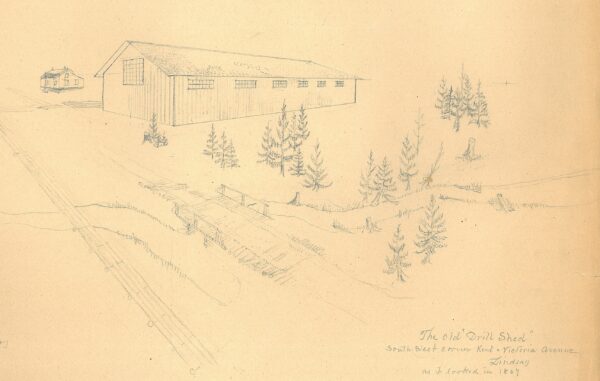
For more than 40 years now, locals have gathered at the southwest corner of Kent Street and Victoria Avenue to buy coffee, doughnuts, bagels, and Timbits at Lindsay’s first Tim Hortons franchise. And over those staples of Canada’s beloved culinary brand, they have no doubt exchanged opinions about the future of their nation – particularly over the course of the last year and a half, when threats of annexation have echoed from across the American border.
Close to 160 years ago, local citizens assembled on this very site to prepare themselves militarily in the event of an armed invasion from the Fenian Brotherhood – a group of Irish-American republican revolutionaries that threatened the sovereignty of a soon-to-be-born Dominion of Canada. These citizens, many of whom would go on to be prominent members of the community, dutifully gathered in a wooden drill shed that had been built at the southwest corner of Kent and Victoria, not long before Confederation, in response to the persistent worry of “Fenianism” in the spring of 1866.

At its core, the Fenian movement sought to achieve independence for the Emerald Isle through violence. Like-minded supporters of this cause in the United States – which was only then emerging from a bitter Civil War – believed that they could effectively hold British colonies (especially what is now Quebec and Ontario) hostage and ultimately intimidate the United Kingdom into backing out of Ireland’s affairs. With the rebellions of 1837 still fresh in the memories of many living in Upper and Lower Canada, respectively, any hint of republican ferocity was met with opposition from those who believed that the future of British North America lay in being just that: British, not American.
Here in what is now Kawartha Lakes, rumours of Fenian sympathizers began to swirl in the early winter of 1865. One report, printed in a New York newspaper and no doubt exaggerated, suggested that there were 400 sympathizers and some 277 enrolled members of the movement living in Lindsay, while Fenelon Falls supposedly could claim more than 330 sympathizers and enrolled members combined. Such claims were seen as an affront to the character of the community. “We need scarcely tell our readers that the whole article, from which the above figures are extracted, is a tissue of the most barefaced falsehoods, without a single truth to give an air of honesty and respectability to the wild ravings of the worthless writer,” thundered a defensive editor of the Canadian Post.
No doubt riled up by an agitated press, people grew more concerned about the possibility of a Fenian invasion. On March 22, 1866, a large and enthusiastic public meeting was organized in the Lindsay Town Hall (now home to the Economic Development office), at which the question of forming a company of volunteers – in other words, a militia – was discussed. Samuel Casey Wood, the county treasurer, moved that “the people of this town should not only organize volunteer companies, but hold themselves in readiness to march to the front, and shoulder to shoulder with our brothers in arms, resist all piratical aggression, and hurl back the invaders of our soil.”
This motion was met with widespread approval, and close to 70 local men signed up to serve. They included such figures as George Matthews, a prominent pork-packer; Adam Hudspeth, a lawyer; George Hughes Hale, who would go on to start the Orillia Packet newspaper; and William Alfred Goodwin, an itinerant painter and decorator. The latter recalled in 1921 that the newly-formed militia had to train in a hall on the third floor of the Union Grammar School, since a dedicated drill hall was still a few months away from being constructed in downtown Lindsay. “We frequently amused ourselves sliding on the frost-bound floor to the great discredit of its leaky roof,” Goodwin remembered of that space. He also recalled that one member of the local militia was accidentally shot and killed while target practice was taking place in a wooded location west of Kent Street. “It is with no regret that the Lindsay company did not have to go to the seat of war nor resume its anti-Christian practice of preparing for war,” concluded Goodwin (who, by 1921, was a staunch pacifist).
Indeed, much of the worry over widespread war was a mite overblown. The 45th East Durham Provisional Battalion, based in nearby Millbrook, was summoned to help quell violence in the vicinity of Fort Erie when the Fenians invaded in what was called the Battle of Ridgeway on June 2, 1866 – but the hostilities had ceased before they arrived. Nor did the volunteer company from Lindsay see action.
Some residents questioned the necessity of it all. Joseph Staples, Warden of Victoria County, said that while he would happily offer his life in defence of his country, he didn’t think it was prudent “for every man in the county to throw up his business, leave his farm unsown, and give up the various industrial pursuits of our fair County because a few hundred Fenians have crossed the line.”
Still, as one contemporary editorial put it in 1866, the Fenians “have elicited a triumphant display of loyalty and courage of the two Canadas, who have sprung to arms to defend their country with a promptitude and energy probably never surpassed.”