
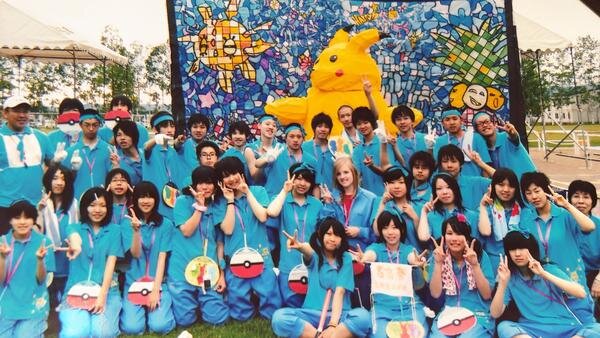
In the heart of Lindsay, where the Scugog River winds past historic brick storefronts, a remarkable international friendship took root in the 1960s, one that would link this community with the northern Japanese city of Nayoro.
In Canada, the sister-city or twinning movement began after the Second World War to promote peace and cultural exchange between communities. Across the country, municipalities established partnerships with cities abroad, fostering student exchanges and business ties to deepen global understanding.
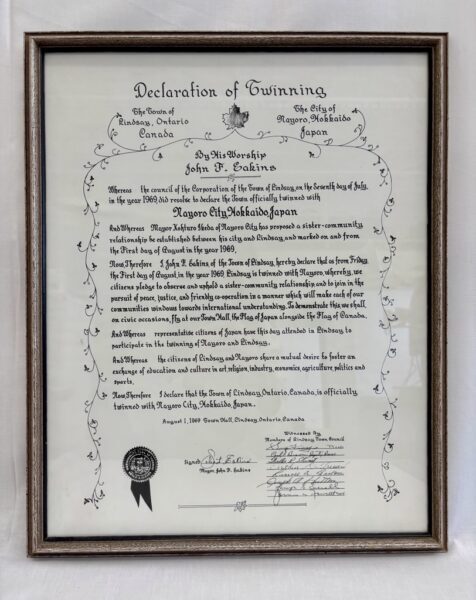
The Town of Lindsay emerged as an early participant in Canada-Japan relations. In 1969, a small group visited Tokyo and met with citizens of Nayoro. Around the same time, Floyd and Doreen Howlett of Lindsay travelled there for work. When Mayor Ikeda of Nayoro expressed interest in twinning his city with a North American community, they suggested Lindsay. The mayor of Lindsay at the time, John Eakins, enthusiastically agreed.
On Aug. 1, 1969, Lindsay and Nayoro formally signed their twinning agreement, establishing the second of 14 Canada-Japan twin cities in Ontario. The partnership was founded on shared characteristics: both communities were regional service centres surrounded by farmland, lay along the same latitudinal line, and experienced long, snowy winters.
In 1970, a delegation visited Hokkaido and was warmly received with formal ceremonies and traditional hospitality. Education became the central focus of the partnership, and Lindsay welcomed its first exchange student, Masaharu Ono, a Japanese agricultural student.
Two years later, teachers from LCVI organized homestays and cultural activities, and students travelled to Nayoro. They exchanged letters and photos and welcomed each other into their homes. For many participants, it was their first experience travelling overseas.
The 10th anniversary of the twinning in 1979 was marked with renewed visits and commemorative gifts. A ceremonial plaque was unveiled in Lindsay’s Town Hall (180 Kent St. West), while Nayoro dedicated a monument to recognize the partnership. Over the decades, mayors and councillors, including Lindsay Mayor Don Crowe in the 1980s and Nayoro Mayor Yukio Yoshida in the 1990s, continued to reaffirm the relationship.
Municipal restructuring in 2001 brought changes to governance, but the spirit of the twinning endured.
For many years, the committee was led by Heather Newman, who helped sustain the student exchange and cultural partnership between Kawartha Lakes and Nayoro. Her dedication earned her the ‘Order of the Rising Sun, Gold and Silver Rays’ awarded by the Emperor of Japan and presented to her by Consul-General of Japan. When Heather retired in 2019 and COVID-19 halted travel, the program lost both its leadership and momentum.
After a pause during the pandemic, the Nayoro Twinning Committee is working to rebuild one of the community’s most meaningful international relationships. Local volunteers, along with the city, have stepped in to ensure the connection continues.
Since 2021, the Lindsay-Nayoro Twinning Committee has been in the capable hands of Dylan Robichaud, a former exchange student to Nayoro in 2009, and the communications supervisor for Kawartha Lakes Police Service. Robichaud describes his time in Japan as, “unforgettable, the relationships made last a lifetime.”
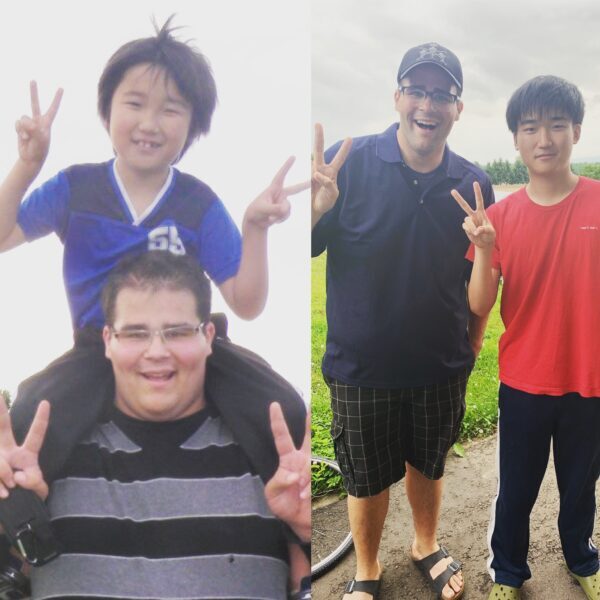
“I have a picture of myself and a young boy, Koki, from one of the host families I stayed with. He is on my shoulders. Over time, he reached out over social media, I was able to meet him again in 2019 when I went back to Japan. When he opened the door, he was so excited to see me.”
Robichaud says the decision to chair the Twinning Committee was driven by a strong sense of responsibility to the community. “I moved back to Lindsay in 2016 and slowly started getting involved with the committee again,” he said. “It’s always been a great connection and a great program for our community. In 2021 I was approached to help take on the committee, and I felt a sense of obligation. I didn’t want to see it just end.”
After several years, the student exchange program is slowly restarting. In 2024, Kawartha Lakes sent high school student Zack Knight to Japan and welcomed Yura Igarashi from Nayoro to Kawartha Lakes.
Rebuilding the program involves reconnecting with host families and reminding residents about the opportunities the exchange provides. Hosting a student is designed to be manageable for families: most families host for just one week. This lets visitors experience life in different parts of the region.
“The hope is that students (from Japan) get to see what it’s like to live in Kawartha Lakes,” Robichaud explained. “From downtown Lindsay to farming communities around Fenelon Falls and beyond, we have so much to offer and for many participants, the experience is life-changing.”
Robichaud’s own trip to Japan was both exciting and intimidating. “I was 17. It was maybe my first time travelling without my parents,” he said. The biggest challenge at first was the culture shock. “I didn’t know any Japanese. In other places you travel, the signs look familiar or the culture feels somewhat similar. Japan was completely different.”
But it was also unforgettable.
During the eight-week exchange, Robichaud, of St. Thomas Aquinas, and Lyndsay Heffernan (nee Bowen) of LCVI, travelled to Japan. They stayed with different families each week, with a wide range of lifestyles. “One week I stayed with a doctor’s family, another week with a farming family,” he said. “I went to a different school every week and even spent time speaking at a university.”
Heffernan remembers that her “exchange to Nayoro was an unforgettable experience, one that few teenagers may get the chance to have.”
“There’s truly no better way to understand a culture than by fully immersing yourself in everyday life, and doing so in a town similar in size to Lindsay made the experience feel both unique and deeply personal.”
Those personal connections are the true heart of the program. “The people and the relationships are the highlight of the exchange,” echoed Robichaud.
Organizers hope more Kawartha Lakes families will consider getting involved, by hosting students or simply learning more about the decades-long friendship between the two communities.
“We’re really trying to rebuild awareness,” he said. “The exchange is one part of it, but the relationship between our communities is much bigger than that.”
Today, more than half a century after its founding, the twinning committee is a testament to the vision of those who believed that even small cities could foster global friendships.
“The Nayoro Twinning Committee has positively impacted our community over the last 50 years,” said Mayor Doug Elmslie. “I am pleased that the city is able to re-affirm its commitment to this relationship this year and, in honour of the city’s 25-year anniversary, update its name to reflect our renewed ties. I have every confidence that the Kawartha Lakes-Nayoro Twinning Committee will ensure the legacy of this significant relationship continues for many years to come.”
As Kawartha Lakes celebrates 25 years, it is an important time to revitalize the relationship.
“For me the hope for the committee is to get back to a regular exchange…. We have so much to offer,” Robichaud says proudly.
This year, the committee is looking forward to sending two lucky students from Kawartha Lakes to Nayoro, continuing a tradition that has connected young people and communities for decades.
Heffernan reflects that she often fondly recalls her time attending school and other events in Japan, “trying so many new foods,” and she encourages others to take part in an opportunity like this.
The Kawartha Lakes - Nayoro exchange remains a powerful reminder of how cultural exchange builds lasting local and global connections. For more information about the exchange, visit kawarthalakes.ca/twincity or email nayoro@kawarthalakes.ca.
Leave a Comment
Your email address will not be published. Comments are moderated.