

From tapping to texting: Telegraphy in Kawartha Lakes

A sunny spring afternoon has come upon Lindsay as a group of senior students from one of the town’s secondary schools make their way across the Rainbow Bridge and walk north or south along the rail trail hugging the shores of the Scugog River. They are glued to their cell phones, watching the latest AI-generated wonder on TikTok – or perhaps pondering which emoticon they should use in a lively conversation with their friends on the other side of town via the miracle of text messaging.
So distracted are these teenagers by their phones that they scarcely notice the ghosts lurking in the bush at the side of the rail trail. Well, these “ghosts” aren’t really phantom spectres; they are in fact thin wooden poles standing about seven metres high (or, depending on their condition, canting out over the surrounding grass and water at an awkward angle). Some of them may still sport blue or uncoloured glass insulators on their cross-arms – if these Christmas bauble-like fixtures haven’t already been claimed by a collector or smashed by an errant rock or snowball.
These are among the last surviving telegraph poles in Kawartha Lakes, and in their heyday the messages their wires carried were awaited as anxiously as text messages are today.

North America’s love affair with electromagnetic telegraphy traces its origins to 1837, when the American inventor Samuel Morse developed an ingenious system of sending and receiving messages via a system of electrical pulses. Represented visually as dots or dashes (for short and long signals, respectively), these electrical pulses were in turn “spelled” out in the form of audible clicking sounds produced by an operator’s skilful manipulation of a telegraph key. Incoming messages were then transcribed onto slips of paper called telegrams and delivered to their intended recipients.
The system spread around the continent, and was especially embraced by those responsible for safe and effective communication along a burgeoning network of railway lines.
The first telegraph wires in what is now Kawartha Lakes appeared about five years after the Port Hope & Lindsay Railway laid its tracks into town along the western shoulder of Logie Street. A succession of snowstorms in February of 1862 had held up the postal system, prompting one editor to plead for the installation of something more efficient. “Now more than ever we feel the want of a telegraph line to this town,” he wrote in the Feb. 27, 1862, edition of The Canadian Post. “We are glad to learn that the Telegraphic Company have the matter under consideration, and that probably we shall, in a short period, be able to communicate with our neighbours, even though the trains cease running.”
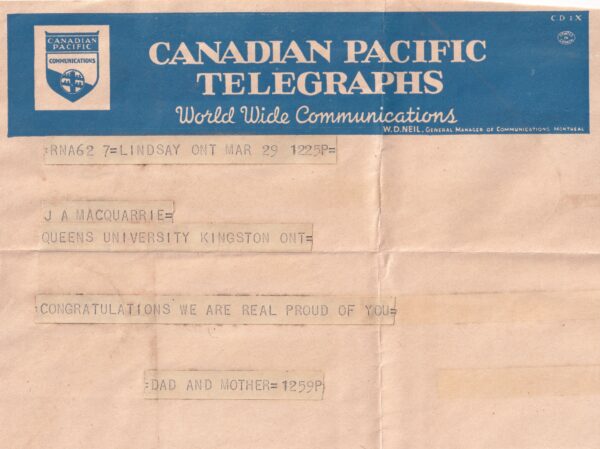
McQuarrie, from his parents upon his graduation from Queen’s
University. In 1881, McQuarrie’s great-uncle, Donald B. McQuarrie,
supervised the rebuilding of a telegraph line for the Baltimore & Ohio Railroad in Missouri. McQuarrie collection.
By the end of the 19th century, with the Grand Trunk Railway’s trains running in and out of Lindsay in all directions, telegraph lines had become a familiar sight on the local landscape. 1904 saw the rival Canadian Pacific Railway build a branch line from southwest of Janetville to Bobcaygeon via Lindsay – and with it came more telegraph poles, telegraph wires, and a demand for telegraph operators.
This latter need was filled by Alex Paton’s National School of Telegraphy, which operated for more than 20 years out of space on the third floor of the Academy Theatre. Here – in what is now the theatre’s storage room for costumes and props – aspiring operators sat at long tables equipped with miniature telegraph poles and learned the art of sending and receiving messages over the wire.
Mr. Paton – a career railway man, sporting enthusiast, and amateur poet – enthusiastically promoted this project among local residents. Young men and women who enrolled in his school were promised lucrative work in the field of telegraphy – not only in Lindsay, but across Canada, too. “James P. Davidson, who recently finished his course at Mr. Paton’s Railway School of Telegraphy in this town has been appointed operator at McTaggart, Sask., near Regina, on [the] C.P.R.,” The Lindsay Post reported on Sept. 29, 1911. A few days before, Paton bragged that Wilson Gillis of Sturgeon Point, Thomas Hetherington of Fenelon Falls, and Harold Evans of Yelverton had all secured positions with the Grand Trunk Railway in Ontario at $50 and $60 a month after taking his telegraphy course. While many of Paton’s protégés went on to work as operators in North America’s railway stations, others found employment in commercial offices or hotels – anywhere to which humming telegraph wires ran.
Not even the telephone – patented 150 years ago this year – could replace the older technology. In a July 22, 1911, letter to the editor, Paton assured readers that he had been informed that “it is not the intention of the Grand Trunk or any other Railway system to dispense with telegraph instruments or telegraph operators.” Indeed, operators were still required even as the older electrical telegraphy gradually gave way to wireless telegraphy, which relied on radio waves to transmit messages.
Change was in the air, though, as railways began to centralize their traffic control operations and later as the internet made inroads in how people communicated with each other. Gone is the clicking telegraph key, but the utility poles dotting the Rotary Trail and Victoria Rail Trail’s south corridor remain as reminders that instant communication is something sought after by every generation.



Thanks for an interesting article.