
‘Empty Seats’ panel discussion on women in politics draws capacity crowd
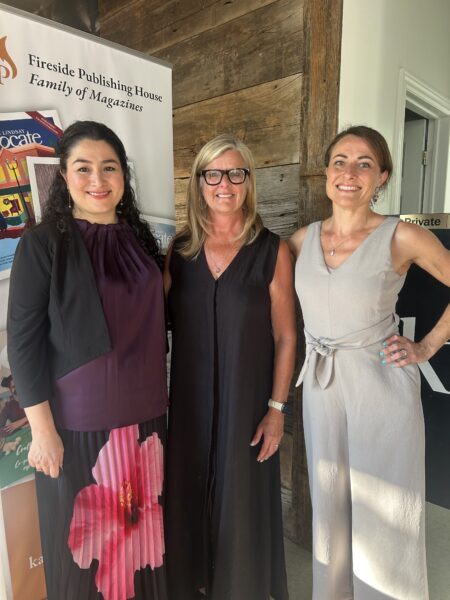
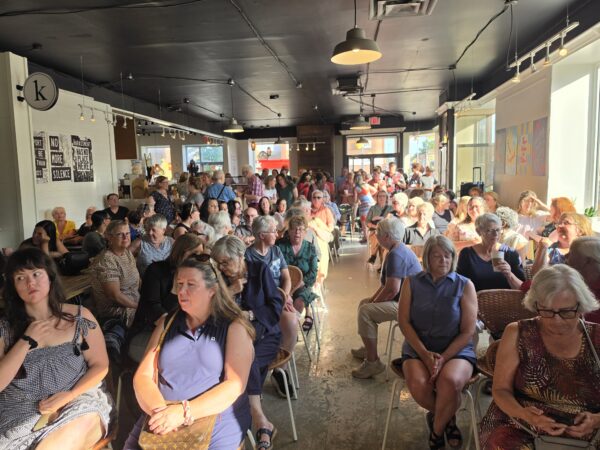
‘Empty Seats’ was standing room only at Kindred Coffee Bar in downtown Lindsay Tuesday evening, a panel discussion about the challenges faced by women in politics.
Hosted by the Advocate and Kindred and sponsored by Launch Kawartha, the evening brought together three area women who know firsthand what it means to serve, to lead, and to withstand the increasingly hostile climate facing women in public life. Coun. Tracy Richardson, former Peterborough Mayor Diane Therrien-Hale, and former MP Maryam Monsef sat down for a frank discussion with Roderick Benns, publisher of the Advocate, and Dara Bergeron, owner of Kindred.

In front of about 150 people, the panelists reviewed their time serving in the public eye, the challenges they faced and what might be done for the future. The evening also featured protest art created by seven local artists. The exhibit will be shown at the Kawartha Art Gallery in the coming weeks to encourage a broader representation and democratic participation of women in politics. The artists were: Rylie Van Halteren, Gillian Steven, Samantha Jones, Christina Patton, Ruth Kelly-Koebel, Sydney Martin, and Jess Spagnolo.
“Every poster brought me to tears because I felt supported,” Richardson said, after seeing the art.
The Ward 8 councillor has experienced a great deal of harassment in her two terms. Richardson said that being a politician in a rural area has both its positives and negatives. While she wants to “encourage and foster the community because Kawartha Lakes is incredible,” people also “know who I am, know where I live and think it’s ok,” to use aggressive tactics both on social media and in person if they disagree with something.
Therrien-Hale’s time as Peterborough’s mayor from 2018 to 2022 echoed some of Richardson’s experiences. It started when certain residents couldn’t believe “that this little ‘girl’” had won, she said. “They never thought I should be there because they were part of that old guard.” While she acknowledges that they are a minority, they often tend to be the “really scary and unhinged ones.”
Richardson added, “We need to stand up to that nonsense together…we need to change the standards.”
Monsef reaffirmed her fellow panelists’ experiences, recalling constituents who felt entitled to send multiple threatening emails or who would just show up at her office angry. “If we are truly serious about more decency in politics we need to invest in more security and safety, starting at a municipal level.”
Another common theme among them was expressing the price their families also paid while they served in public office. “Can I continue to put my family’s privacy and safety at risk,” Richardson said, as she made the decision to step away from the upcoming election. Widely perceived as a mayoral frontrunner had she decided to put her name on the ballot, Richardson, instead decided not to run for a council position at all.
Monsef implored other women in the audience to run. “Please run – you are the agents for change,” she said.
“We are all people and just want our communities to be the best they can be,” Therrien-Hale said, and yet noted that there appeared to be a “downward trend in political literacy,” with social media “engineered to support the harassment.”
“Social media is not the news and most of the time it’s not the truth,” Richardson added, who talked about an uphill battle to educate constituents.
All panelists agreed it’s important when male councillors or other male politicians call out bad behaviour towards women. They also noted that improving the political climate for women to run for office improves things for everyone. Monsef made a passionate plea to encourage people to push back against unfair posts on social media and keyboard warriors where possible.
A petition was passed around at the event that will eventually be sent to Kawartha Lakes City Council, asking the municipality to look into ways it can be of more support to councillors.
From coast to coast, women are weighing whether public office is worth the personal cost. Some decide not to put their names forward at all. Others step away after one term or leave political life entirely. The pressures vary, but abuse online, threats in person, and a harsher tone in public debate have made elected service increasingly punishing for many women.
Research released in 2025 by the Canadian Municipal Barometer points to harassment as a growing factor behind early resignations and decisions not to run again at the local level. It also suggests that this climate is discouraging potential candidates from stepping forward, with women especially affected.


It was a great event and so very well attended. Well done, Kindred, the Advocate and Launch Kawartha. I think it is important for politicians of all genders and sexes to remember that their constituents experience the very same sorts of harassment on social media as they do. I took one threat to police because the account said it knew me, knew where I lived, knew where I walk my dog, and was coming for me. The constable who helped me with that went into the back of the KLPS station to look into it and when he came back he told me the account was located somewhere in Scandanavia and was associated with a group that liked to fantasize about torturing to death its victims and eating them. Threats from those sorts of accounts are what the BLOCK function is for. But when harassment spills over into real life, we need to take it seriously. Life is hard and filled with risk and there are a lot of very damaged people living amongst us who struggle with their demons and sometimes fail who blame all their woe on elected officials. When they approach a politician at the grocery store and say to their face, “I am going to kill you” or when they park their vehicle outside a politician’s home and sit there all night, or when they leave repeated voice messages screaming unintelligible gibberish, police must follow up. The lines between criminal behaviour, mental illness, and free speech is not as fine as some may think. Criticize your councillor’s political activities, views, policies all you want, using civil, legal means – freedom of expression is our right under the Constitution – but avoid the criminal activity detailed by the Criminal Code at https://laws-lois.justice.gc.ca/eng/acts/c-46/section-264.html
Because elected officials are representatives of the public good, our voice at City Hall, so to speak, I think a line should be added to the budget to provide them with better security resources.