
Century home’s lush gardens rooted in a quest for inner peace
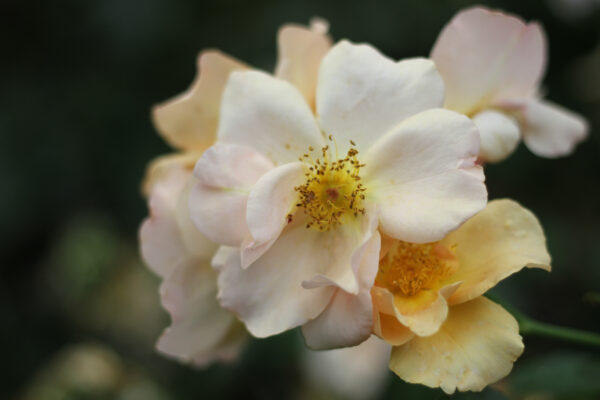
Behind an ornate metal fence on a quiet Lindsay street in the old north ward, a circular rose garden greets visitors like a formal introduction. But it’s only the beginning. Step behind the century home and the property unfolds into four distinct gardens, each with a story to tell and shaped by time and the patient vision of the owner — a patio, a pond, ancient walnut trees and a scattering of charming, diminutive buildings that make the space feel more like a small country estate than an in-town home.
The house rises quietly behind a veil of mature trees, its steep gables and warm brick speaking to a different century. The home reflects an early Victorian sensibility, later likely softened by the addition of decorative details that hint of the then modern Queen Anne style coming into vogue. Its asymmetrical lines and patterned gables give it a quiet charm, but it’s the gardens and gifted owner that bring the property to life.

Roger Calverley purchased the grand old homestead in 2000. While calendars were flipping to a new century and millennium, his eyes were turned to reviving his 1873 property.
Calverley said after researching, there appeared to have been a double row of what he thinks were maple trees out front of his home. “Not a lot of space between them but enough for a cart and a horse and buggy to pass.”
While the odd Mennonite horse and carriage traverse the street to avoid downtown Lindsay traffic, now you are more likely to see families pushing baby strollers, dog walkers, and students heading to school under the cooling canopies of century-old trees.
You wouldn’t be wrong to stroll past the front garden and assume a small wedding was taking place in the Calverley rose garden. But the group dressed in white, gathered behind the ornate black fencing, is more likely deep in meditation.
Calverley’s idea for ornamental fencing helps to keep people and dogs off his lawn but serves as an important design consideration as well. He says it’s like framing a picture. “If you get the right frame, the picture will look really good.”
When he moved into the home, there wasn’t a fence and the front lawn consisted mainly of grass with big old maple trees, though they have since lost three or four of these trees over the years.
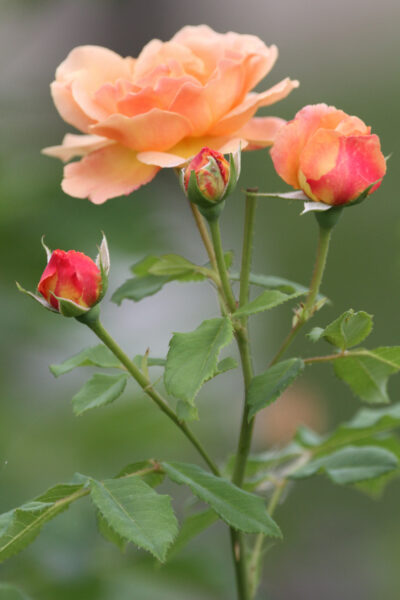
The front plot has been transformed into an extensive rose garden of sight, sound, and smell. It contains up to 180 rose bushes, representing more than three-quarters of that number in varieties, Calverley told the Advocate.
The olfactory beauties give off sweet, floral, fruity, and slightly spicy scents that develop over time, with most aromatic.
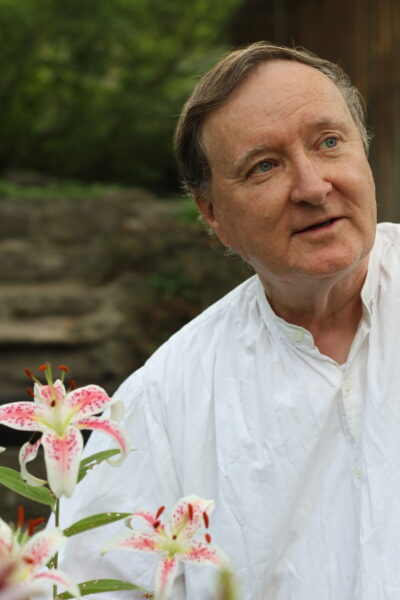
He designed the garden with a circular theme, explaining that once you place a circle at the centre, it’s harmonious to work with curves rather than sharp edges and square lines. “That defines what looks harmonious with the rest of it.”
Calverley was born in Toronto where he studied the harp and piano. He is a writer, new-age musician, composer, retired educator, and home gardener extraordinaire. After gardening for most of his life, he still looks youthful and boyish, despite decades outdoors. His secret is not sunscreen, but comes from within, although being able to garden under the shady trees is a good
SPF. He meditates for an hour or two daily, partakes in a half-hour walk, continues to garden, composes and plays music, practices calligraphy, writes and publishes, and enjoys life.
“I would say inner peace is the key.”
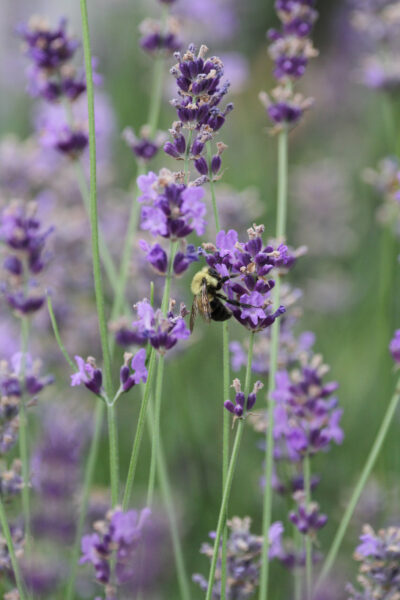
Edging the rose bushes are lavender plants, grown from seed placed there by Calverley. The lavender scent is pleasant. You will also hear gentle buzzing as bees flit around, foraging for food to support their colonies. Calverley says lavender is also known for its practical benefits, including discouraging certain pests, like rabbits. It is also a design element. “I think that the texture of the leaves offsets the look of the roses.”
The rose garden is anchored by a sizable, sacred stone — an object rich with meaning across cultures and faiths.For Calverley, its significance is grounded in the spiritual traditions of India.
Calverley says the roses are healing. He is somewhat of an expert on the subject, authoring the book, The Healing Power of Roses, available on Amazon.
Introduced to roses as a child by a kindly aunt, his fascination quickly blossomed. By high school, he was not only growing his own plants but also teaching family members how to care for their own. His creative instincts showed early — his roses became corsages for his sisters’ graduations and heartfelt gifts for those he loved.
In later years Calverley began to use roses as a healer, and teacher of radionics. His book notes he learned how to apply their vibrations, tinctures, and uses to heal from a distance. Calverley said his current rose garden was not consciously chosen for the healing aspect, but the energy of his home has nonetheless changed. “It feels more suffused with good energy and spiritual presence.”
Rounding the corner of the home, you enter a brick-covered courtyard, and the sounds of the distant downtown are softened. The hush is brought to you by heavy foliage, tall trees, blooms, and the expansive 2.5 storey, sound-absorbing manor. Wooden steps and extensive brick sidewalks access the next area. There are trellises that delineate you’re walking into a new and distinct area.
Calverley says the features that were there from the beginning, and “probably for 100 years,” are the four or five big old walnut trees.
“It’s almost like a jungle canopy. You look way up and you’ve got shady walnut trees.”
Black walnut trees have roots that create toxicity in the soil. “That’s what you start working with and you want to find something that will be aesthetically compatible with the trees, and which will survive the toxic soil.”
He said hostas were perfect as they like shade and don’t mind the soil. “They look very green and lush. At times they almost look tropical.”
Soil remediation followed the removal of a black walnut tree from the rose garden out front to ensure the roses could thrive.
As Calverley enjoys a meal on his back deck adorned with a table and chairs overlooking a pond, you may also see hungry, puffy-cheeked squirrels moving quickly across the gardens, pausing to stand on their hind legs to scan for danger while looking for nourishment to tuck away for the colder winter.
Other critters enjoying the oasis include Calverley’s dog and cat, Beanie and Daisy.
Below the dining area, a tranquil pond with a bubbling waterfall features minimal specific plantings, with some foundation planting on the stonework and one or two hostas.
Koi and goldfish provide more swishy movement in the pond with a mix of graceful patterns and occasional bursts of high energy. The latter were born and bred in situ.
Just when you think you are at the end of the three-quarter acre property, an aged fence opens up to a darkened, moody walnut “forest.” It appears as a very natural, wild art gal-
lery, with absolutely nothing contrived. This area features many black walnut trees, some still battle-scarred from the 2025 ice storm. Long before the house was built or Lindsay’s streets were laid out, one massive black walnut tree had already begun its climb skyward about 300-years ago. Calverley figures it is the largest in Lindsay. “(It) takes three people holding hands to span the trunk of that tree.”
This rear black walnut sanctuary also features a tree branch that runs parallel to the ground. Calverley says it goes on and goes on and “stretches out like a branch that Tarzan would walk along.”
The back of the coach house creates a private corner in the black walnut woods. Calverley says he built a deck around the massive tree. Despite this area being large enough for another house and a backyard on the property, it’s not used as much as the other gardens.
A long driveway takes visitors to the carriage house near the back of the place. The drive, originally paved with stones and ready for horses and buggies, now features brick underfoot. It’s another improvement Calverley made that adds character and depth to the property.
rose garden was not
consciously chosen for
the healing aspect, but the energy of his home has nonetheless changed.
Calverley’s advice for someone planning their own garden? He advocates an organic approach where property owners start with one idea that works with existing conditions, complete it, and build upon it, part by part. He emphasizes that this method creates unique, beautiful results through organic growth rather than linear logic, citing his own transition from crushed white gravel to brick walkways as an example.
Here and there, smaller outbuildings dot the property, rich in character and likely with untold stories. Their varied architectural elements conjure images of over a century past, when gardeners, cooks, and household staff lived and worked within these now-charming spaces to look after the main house and residents.
After 26 years, the garden is still evolving. Trees grow taller, beds fill in and new ideas take root. But beneath the canopy of walnut trees that may have stood here for three centuries, and newer roses underfoot, the gardener says the real reward is simpler: Calming the mind and then resting in recognition.
About Black Walnuts
Black walnut trees (Juglans nigra) are common and thrive in Kawartha Lakes. They are native to Southern Ontario and can grow up to 30 metres.
Squirrels do an excellent job of spreading nuts and propagating the trees. They easily spread in gardens and on lawns.
While they are excellent for shade, gardeners curse them for their toxicity, spreading the chemical juglone and leaving messes. Calverley says his hostas have been successful as one of the plants that tolerates black walnut trees.
Squirrels are not the only creatures that enjoy black walnuts. A few companies process them for human consumption as a snack. The thick green outer husk is removed, followed by washing, and then the nuts are cured and dried for several weeks before being cracked open. Your Christmas nutcracker is not up to the job, which is why you don’t see regular residents processing their walnuts.
These high protein treats are used in baking and as a ready-to-eat snack. Some are caramelized for a sweet treat as well.



Beautiful writing. If you play classical music it helps your plants grow
Thank you for sharing an excellent article and beautiful photos of the plants and flowers creating a quiet place of reflection.
Very well written, Denise. I enjoy driving slowly by this enchanting home. I look forward to seeing the front rose garden in bloom.
Having lived on Wellington St. I appreciate the beauty, and bane, of the black walnut trees. Hostas are a good choice for greenery near them.