

Boomers, ballads, and broken promises
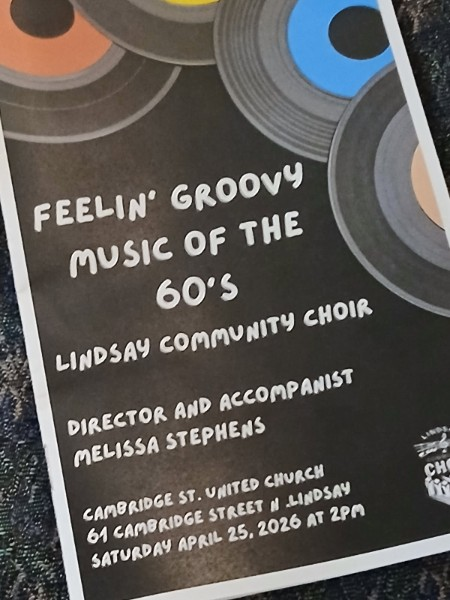
When my wife, an alto in the Lindsay community choir, invited me to the ‘Feelin’ Groovy’ concert a few weeks back at Cambridge Street United Church, I couldn’t wait for an afternoon of nostalgia and a long overdue plunge into live 60s rock, the soundtrack to my coming of age.
The slide show before the program promised there was more than classic hits ahead. Flanking the nave, two huge monitors high above our heads were playing flower-power, counterculture and protest images that dissolved in and out of familiar poses of Beatles, Stones, Supremes, Simon and Garfunkel, Hendrix, Mamas and Papas, all mixed in with colourful slides of Peter Max-style wordmarks, “Far Out Man” “Outa Sight” “Groovy”, and of course, the famous Woodstock album cover of the blanket-wrapped hippie couple, behind them thousands of ‘freaks’ are chillin’ on the hillside of dairy farmer Max Yasgur’s 600-acre spread he gave over to the iconic 1969 peace and music festival.

The pews are packed with fellow travelers, mostly silver hairs like myself, we form a substantial semi-circle around the flower children in the choir who deliver their affectionately arranged anthemic earworms with all their tie-dyed hearts. The evening was like stepping into a satisfying shower of hymns from our time, many of us betraying familiarity with the material by mouthing along to unforgettable, or was it only just now re-remembered lyrics?
The program unfolded as advertised, but what I did not see coming was the trigger.
Nope, it wasn’t the heart-tugging rendition of ‘Stand By Me’ that set me off, not even the soaring strains of ‘Ain’t No Mountain High Enough’, two of my all-time favourites.
What got me right between the tear ducts was the emcee. Somebody had the brilliant idea of writing a script to go with the music.
“Each of the songs you hear today will have arisen out of the political and social climate of the 10 years,” promised the mistress of ceremony. She read from the historical record, as it were, the context behind the music of a most ‘transformative decade’ as she put it. She wove familiar era-defining highlights expertly in and out of the choir’s delicious musical sets, beginning with the Tokens’ 1961 instant classic, “The Lion Sleeps Tonight.”
“The 1960’s was a transformative decade defined by extreme social upheaval, political shifts and a global revolution in popular culture,” she began. “It is frequently remembered for the ‘counterculture’ movement.”
I look around and reflect on how we stooped and gingerly seated old things lived through what is being narrated about us. I recognize that this ‘congregation’ of boomers did not necessarily experience ‘the social upheaval and the cultural revolution’ in exactly the same way. Not all of us were paid up members of any counterculture movement, or, if we were, we’re certainly not now.
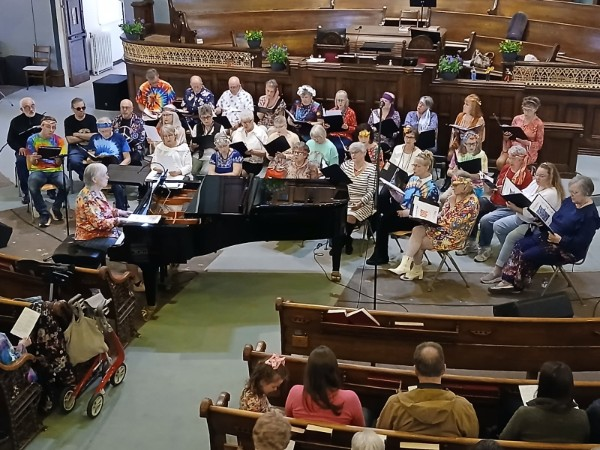 And I know where I am. I’m in conservative Ontario heartland where one woman’s ‘cultural transformation’ might be her neighbour’s ultimate sin against God. Although I’m relatively new here, I’ve always had the sense that the patriarchs and the matriarchs in these parts do not suffer change gladly.
“Youth – specifically the post-war Baby Boomers – rejected the conservative norms of the 1950’s in favour of civil rights, peace and individual expression.” That reads so well on paper and it’s exactly what I’d love to tell my grandkids. But we did no such thing, at least not for keeps.
We did not reject conservative norms. In fact, a particularly virulent strain appears to be having its way with our civil rights as I type, if you go by bills C-5, C-15 and other Canadian lawfare that has historically sought to override Indigenous sovereignty; expect your individual expression to be criminalized next time you protest against Israel, and cancellation awaits you should your social media posts colour outside the lines of establishment-approved narratives. And, when we look around for ‘peace in our time’ all we can see is war – Iraq, Afghanistan, Syria, Lybia, Ukraine, Iran, Lebanon, Gaza, Sudan; so, what peace was it exactly that we achieved?
After the narrator’s opening salvo across the bow of beloved mothership ‘Nostalgia’, I’m now hanging on her every word with furrowed brow and find myself, between musical sets, doing some serious, self-loathing boomer bashing. I swallow hard at how our peacenik generation never did live up to the hype, even as the overfamiliar tale I always wanted to believe about our countercultural ways, slides too easily and too predictably off the emcee’s page into my sensitive and critical ears.
“Along with political instability came a massive shift in the fight for equality and justice. The Civil Rights Movement was a pivotal struggle for African Americans to end legalized racial discrimination.”
Case in point, the 1963 Children’s Crusade in Birmingham, Alabama. Unforgettably violent TV images from the iconic civil rights march that penetrated Canadian living rooms, of high-pressure fire hoses and vicious police dogs tearing into black student demonstrators have been replaced eighty years later by viral news footage of contemporary police brutality – the deadly knee of a white Minneapolis cop on George Floyd’s black neck; masked ICE officers in full battle gear busting down doors and tearing children from parents in their homes for immigration violations. Racialized, institutional violence in our time is so rampant and systemic, we’re back to building requisite self-protective movements like Black Lives Matter (BLM), today’s NAACP, then: the National Association for the Advancement of Colored People.
Lore has it that public outrage at what happened in Birmingham is what finally pressured the Kennedy administration to risk provoking local Democratic Party leadership and do something about civil rights in the South. Eighty years after supervised desegregation by National Guard black Americans continue to have their civil rights violated daily – at work, inside institutions, at a traffic stop.
The choir is into the best of the Beach Boys, not my favourites, my brain travels elsewhere.
In Canada we like to keep the civil rights conversation stateside. Our racism wasn’t Jim Crow-legislated, so we breeze past without looking at the false front of 1960s Canada, the welcoming non-racist promised land.
In his 2020 chronicle, The Skin We’re In: A Year of Black Resistance and Power, journalist-author Desmond Cole makes it clear that racial issues in Canada are “slips of the mask”, and not accidental, “because the system is intentionally designed for surveillance and discipline.
We’re talking about a system of power that seeks to benefit white people above all others.”
As for the ‘non-racist promised land’ of the 1960s, tell it to Black Canadians who had their historic community of Africville demolished by the city of Halifax (1962-70) to make way for developers. The city’s MO of relocating residents against their will resonates loudly to this day with Indigenous communities.
Canadian residential schools were in full ‘swing’ in the 60s, and the culmination of forced assimilation of Indigenous people that came to be known as the “Sixties Scoop” was the ultimate discrimination against Indigenous culture and family traditions. Officially launched as a Eurocentric child welfare initiative, ‘child protection’ authorities would swoop in and apprehended thousands of Indigenous children—often without consent or knowledge of parents or bands—and placed them in non-Indigenous foster or adoptive homes. The lasting intergenerational trauma endured from this cultural genocide is finally, generations later, getting some national attention in mainstream media. But at the time, news organizations largely ignored, even tacitly approved the ‘scoops’ by running ads for “Adopt Indian and Métis” programs, which in effect facilitated and manufactured approval for the removals.
During the next set I move my teared-up self to the privacy of the empty balcony upstairs for a better view, and for better picture taking. The choir launches into a most enjoyable set before intermission, ‘Sherry’ by the Four Seasons, ‘Under the Boardwalk’ by the Drifters and the Who’s ‘Pinball Wizard’ while I critically hold up the state of the world and compare it to how it was on our watch. That doesn’t keep me from singing along out loud and out of tune from the safety of my lofty perch in the bleachers.
“Youth, the world over, led protests against war and social injustice. Marches and sit-ins were peaceful protests on and off campuses and punctuated with shouts of “Ban the Bomb”, “Make love not war”, “We shall overcome”.
I remember the slogans, but I can’t remember shouting any out loud. However, I do recall my baptism, as a freshman who knew squat about the world, to anti-war protesting, and I do remember shouting out loud with Country Joe MacDonald and the Fish Cheer, “Give me an ‘F!’…Give me a ‘U!’…”
Here’s the occasion:
Country Joe’s iconic 1967 anti-Vietnam war anthem, “I-Feel-Like-I’m-Fixin’-To-Die Rag”, – One, two, three, four, what are we fighting for? – was raging over the loudspeakers in the Carleton University tunnels, which were constructed under the campus in 1947, ironically, to give disabled WW II vets better access to classes.
The Sarnia, Ontario manufacturer of napalm that was supplying America’s Vietnam war machine had met resistance on Canadian campuses across the land including sit-ins and lockdowns and in the case of U of T, faculty and student actions got administration to cancel future interviews. In Carleton’s case, somebody spread it around that Dow interviewers and interviewees were to make their exit through the tunnels via the MacOdrum library. There we all were, shoulder to shoulder at a major tunnel intersection, where I strayed into the group of well-dressed, buttoned-down young men running the gauntlet of long-hairs, and a rather less nattily attired crowd letting them have it, in unison, and loud: “One, two three, four, we don’t want your f*****g war!”
Undeterred by campus protests, Dow Chemical continued to make napalm for the US war effort, and continued to hire university chemistry grads until the war was over.
Today Dow Avionics and Dow Aerospace and Defense, two new Calgary-based divisions, specialize in the manufacture of war materials engineered to withstand extreme flight and combat conditions. War is good business.
Country Joe and the Fish did not make it onto the afternoon’s program, but other, more familiar ‘protest singers’ did.
“Sparked by the Vietnam tension, Pete Seeger, Joan Baez, Bob Dylan and others wrote and made famous songs of protest.” The emcee invites the audience to sing along to Seeger’s ‘Where have all the flowers gone?’ and reminds us that Seeger “was blacklisted during the McCarthy era but never gave up his need to capture in song the senselessness of war and social injustice.”
I look around, to see if it’s still safe to sing along to one of my all-time favourite tear jerkers. A couple of others have come up to the balcony for better pictures. I refuse to let my self-indulgent reflections about coulda-shoulda spoil my enjoyment of tonight’s concert and belt along.
And I know there are at least two generations lined up behind us doing a perfectly good job of holding us accountable on a number of scores including a more equitable world, a world free of oppression and war. But man, are they ever ‘diggin’ our music. The playlists of my kids and even their kids are packed with classic rock, Creedence, Pink Floyd, Crosby Stills and Nash, Chuck Berry. Here’s hoping some of our peacenik stuff will rub off on them as well.
“The choir would like to leave you with one final number before they ‘split’”, our emcee sets up the ending to a memorable afternoon of music and memories with her intro to an all-time soppy favourite, ‘He ain’t Heavy, He’s my Brother’.
“…originally recorded by Kelly Gordon in 1969 the song became a worldwide hit for the Hollies. It emphasizes the spirit of brotherly love and compassion that flowed from the hippie movement.”
Ahh. We can only hope.


…and important reminder of just how far we have yet to go. Well done, Peter!
Hey Peter. Well written and thanks for the walk through our defining era
Thanks for writing and sharing Peter. Great article!
What an amazing insightful summary of the times. I loved singing in this choir. Now I have the story behind the songs. Thx so much for this article.