

Council signals interest in Project Lifesaver program to help those with cognitive impairment
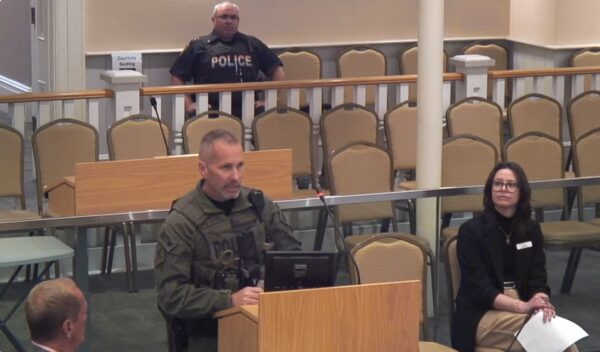
During the latest committee of the whole meeting, council voted to receive a recommendation to consider adopting a public safety program aimed at helping emergency services locate people with cognitive impairment who are prone to wandering.
At the June 2 meeting, Kawartha Lakes OPP Sgt. Ryan Weir delivered a presentation accompanied by a report on Project Lifesaver, a program with a proven track record of helping locate people with cognitive impairment who have gone missing from their caregivers.

Project Lifesaver, which has been implemented in several other Ontario communities for about 20 years, is a U.S.-based nonprofit organization that assists law enforcement, paramedics and search-and-rescue teams in locating people with cognitive impairment and neurodevelopmental disabilities who have wandered.
According to the Project Lifesaver website, the program has made 4,605 rescues.
The program partners with local agencies, whose personnel receive specialized training in radio-frequency tracking equipment and search techniques designed to locate individuals who may wander due to cognitive impairment or other disabilities.
Participants wear a small transmitter, about the size of a watch, on their wrist or ankle, that emits a unique signal. If a participant goes missing, caregivers notify emergency responders, who use the signal and tracking equipment to determine the person’s location and return them safely.
In the event a program participant goes missing outside an area where the signal can be picked up by the receiver, the operator will put a multidirectional antenna on the roof of the tracking vehicle and will drive slowly in larger circles until they pick up the signal and can identify the direction to follow.
“The success rate boasted by Project Lifesaver is normally within a 30-minute timeframe from the time they’re reported to the time they’re located,” Weir told council.
A major benefit of Project Lifesaver, Weir added, is the cost, which, he said, was around $18,000 for the whole system, which included two receiver kits plus 10 transmitters for participants. The cost of training is absorbed by the police services, he said.
In order to be a participant in the program, applicants must live in Kawartha Lakes; have a condition that causes wandering, such as dementia, intellectual disabilities or brain injury; and have a caregiver or support person who can provide daily and monthly battery checks.
In April 2025, the Kawartha Lakes OPP and the Alzheimer Society of Peterborough, Kawartha Lakes, Northumberland and Haliburton began working with the Kawartha Lakes Paramedic Service to bring Project Lifesaver to the city.
Project Lifesaver is slated to launch in the city this summer. Officers from the OPP and the Kawartha Lakes Police Service have been trained in using the technology, while the Alzheimer Society is leading participant enrolment and the program’s co-ordination.
Following the presentation, Mayor Doug Elmslie voiced his support for the project.
“What a great program and how well required it is in this day and age,” he said.
Deputy Mayor and Ward 8 Coun. Tracy Richardson lauded Project Lifesaver as “an excellent example of community collaboration.”
Richardson queried Jen Johnstone, the Alzheimer Society of PKLNH’s executive director, who also spoke during the presentation, on how many participants Project Lifesaver could expect.
Johnstone said it will likely be small to start, but she added there will likely be increased demand in the coming years as the number of people living with dementia is expected to rise significantly by 2050.
“Having this infrastructure developed now … is really well timed,” Johnstone said.
Information about accessing Project Lifesaver can be obtained by calling the Alzheimer Society of PKLNH at 705-748-5131.



Great idea!! Go for it, Council!!