
The Hilton Family of Hilton’s Point Road, Laxton
Like many communities, Kawartha Lakes features roads and streets named after significant landmarks, influential individuals, and pioneering families who helped shape the region. These names offer a window into the past, providing glimpses of the people and places that once defined the area and invite us to reflect on their historical significance.
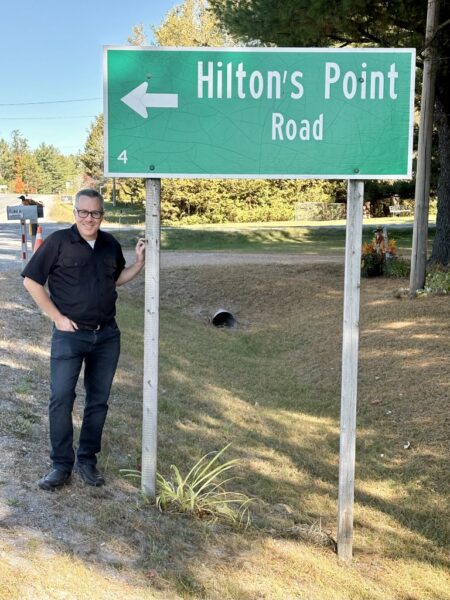
Situated on the east side of Head Lake, Hilton’s Point Road takes its name from the Hilton family, among the region’s earliest pioneers whose presence marked the beginning of local settlement.

John and Elizabeth (née Greenwood) Hilton came from families who worked in the dangerous and unhealthy cotton mills near Manchester, England. Seeking a better life for themselves and their six-year-old son, David, the couple emigrated to Canada in 1857. John was 28 at the time, and Elizabeth was 32. Travelling through New York, the Hilton family crossed Lake Ontario and landed in Port Hope before spending a year or two in Cavan Township.
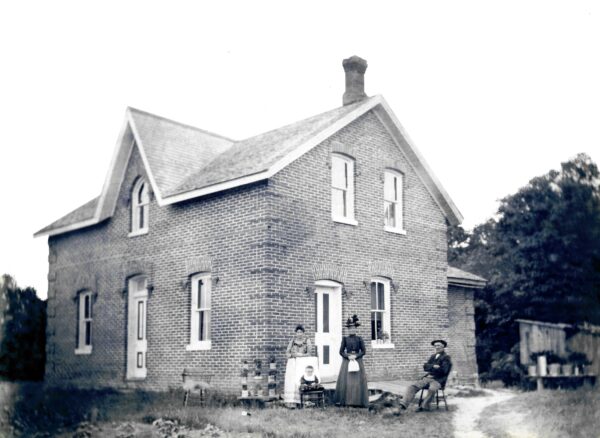
By 1861, the family of three had settled in a one-room log house on the east side of Head Lake, in Laxton Township, on the edge of the Canadian Shield. There, John cleared trees, removed rocks, and began farming the rugged land. After meeting the government’s settlement requirements, clearing part of the property and paying $135, the 148-acre Hilton family farm on Concession 7, Laxton Township, was officially registered in David Hilton’s name on March 20, 1874.
The Crown grant was sealed by ‘Queen Victoria, by the Grace of God, of the United Kingdom of Great Britain and Ireland, Queen, Defender of the Faith.’ Intriguingly, a later deed dated April 23, 1881, saw David transfer the property to his father, John, in exchange for $500. The exact reason why the original grant was made to the son and the lands were later transferred to the father remains a mystery.
The Hilton family lived in their original log house for 21 years, until 1882, when a brick home was built on the property. John Hilton passed away in 1892 at the age of 63. Shortly after his death, Sir Sam Hughes wrote in the Victoria Warder newspaper that John Hilton had been a well-respected farmer whose final act before passing was to travel into town by horse and buggy to cast his vote for Sir John A. Macdonald in the 1891 general election.
John Hilton’s Last Will and Testament, dated Oct. 10, 1891, reveals the close bond between the small family. In it, John bequeathed his entire estate to his son, David, on the condition that David provide his mother, Elizabeth, with a comfortable home for the rest of her life. Sadly, Elizabeth passed away the following year, in 1892, at the age of 67. Both John and Elizabeth Hilton were laid to rest together in the Pine Grove Cemetery at the corner of Hilton’s Point Road and Highway 35, just north of Norland.
Meanwhile, David Hilton’s personal life took a joyful turn in 1889 when he married Margaret Jane Bailey, daughter of James Bailey and Margaret Jamieson. Sadly, their happiness was short-lived-Margaret passed away in 1898 from dropsy – another term for edema, meaning the swelling caused by fluid buildup in the body’s tissues. Despite this loss, on Nov. 21, 1900, at the age of 48, David married Jane “Jennie” Prudence Montgomery, the youngest daughter of John Montgomery and Catherine Fee of Janetville.
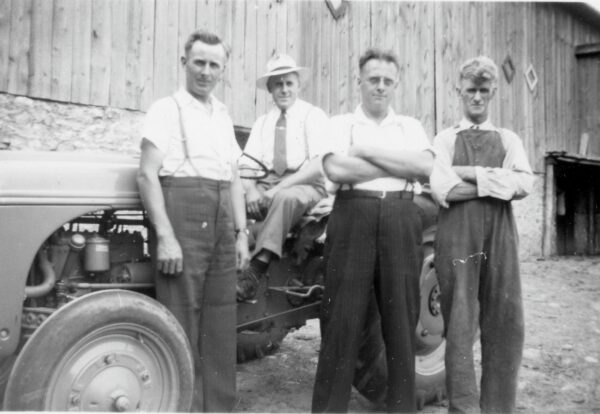
Together, David and Jane built a warm and thriving home on Head Lake. In 1902 and 1903, they welcomed their first two children, John (“Jack”) and Archie. It was also around this time that Jane’s older sister, Mary Ann Montgomery, joined the household after the passing of their parents. She became an integral and cherished part of the Hilton family, where she lived for 34 years until her death in 1937.
In 1907, David Hilton sold the Head Lake farm to neighbouring farmer Alfred Newton Winterburn for $2,700. The Winterburn family took over the property, carrying on its farming legacy until 1940. In 1908, the Hilton family moved to 43 Water Street in Coboconk, settling in a house along the Gull River. During their five years in Coboconk, David worked at the local sawmill, engaging in physically demanding labour to support his family.
Another moment of joy arrived on July 1, 1910, when David and Jane Hilton welcomed twin boys, Wesley (“Wes”) and Alwilda Theodore (“Ted”), further expanding their growing family.
When the twins turned three, David was diagnosed with a heart condition that prevented him from continuing the physically demanding work at the sawmill. As a result, the Hiltons moved to 56 Angeline Street South in Lindsay, directly across from the present-day Leslie Frost School. The deed recorded the purchase of their new home, along with a four-acre lot, at a price of $1,500. With his health limiting strenuous labour, David transitioned into a less demanding role as a groundskeeper at a local golf course.
In March of 1922, with Jack nearing 20 and Archie soon to celebrate his 19th birthday, David felt the boys were ready to take on the physically demanding work of farming, a job his heart condition no longer allowed him to do. The Hilton family, then consisting of David, his wife, his sister-in-law, and their four sons, moved once again, this time to a farm east of Lindsay, located on Downeyville Road, Lot 21, Concession 10, Ops Township. For the next 10 years, David and his family devoted themselves to working the land, until his passing on July 16, 1932, at the age of 80. He was laid to rest in Lindsay Riverside Cemetery.
Life on the farm during the Great Depression of the 1930s was challenging for the Hilton family. Jack and Wes found some work connected to the construction of Highway 35. By 1935, both Ted and Jack had married and left the farm. Jack devoted himself to his career with the Canadian Pacific Railway (CPR), while Ted moved to Toronto and Oshawa, first working as a milkman and later as a service station operator.
In 1936, Wes was living in Lindsay, employed by Purity Bakery and later Trent Valley Bakery, delivering bread throughout Haliburton County to camps and resorts. By 1937, Archie Hilton – the last of the Hilton brothers remaining on the family farm in Ops Township – left for Toronto in search of work, finding employment first at the Don Valley Brickyard and later with the CPR as a freight car checker. Wes stayed in Lindsay to care for his mother, Jane.
The Hilton family farm in Ops Township was leased to a tenant for several years and ultimately sold in 1939. In 1940, Wes married Brenda Hutchinson. In addition to managing his bread delivery route, Wes also assisted with the Hutchinson family farm on Post Road, east of Lindsay. That same year, Jane Hilton moved to Toronto to live with her son Archie. After Archie’s marriage in 1942, she resided with him and his wife, Agnes. Sadly, just as the Second World War was ending and only a few months before Archie’s first child was born, Jane passed away at the age of 76. She was laid to rest in Lindsay’s Riverside Cemetery alongside her husband, David, and near her sister, Mary Ann. Riverside Cemetery also became the final resting place of David and Jane’s sons, Jack and Wes Hilton.
After approximately 164 years of settling in this area, the Hilton family remains a proud part of the community. Over the generations, family members have left for school and work but have always chosen to return to raise their families. John David Hilton, a great-grandson of John and Elizabeth Hilton of Hilton’s Point Road and a grandson of David and Jane Hilton, now lives just a few blocks from the Lindsay Fairgrounds. His son, Edward, also calls Lindsay home.
Today, the Hiltons continue to embody the same spirit of resilience, dedication, and community that brought their ancestors to this region so many years ago. Their story is not just one of family roots, but of enduring connection – to the land, to their neighbours, and to the generations who have helped shape this area into the place they still proudly call home.
This article would not have been made possible if it were not for the invaluable files, research, and photographs from the personal collections of the Hilton Family. Kawartha Lakes’ Moments and Memories project records, shares and celebrates the intangible stories of our communities. For more information about this story, any other story, or to share your own, contact Laura Love at or visit www.kawarthalakes.ca/yourstories



Interesting. And what a lovely photo of our Edward.