
The Baby Boom – 80 years on
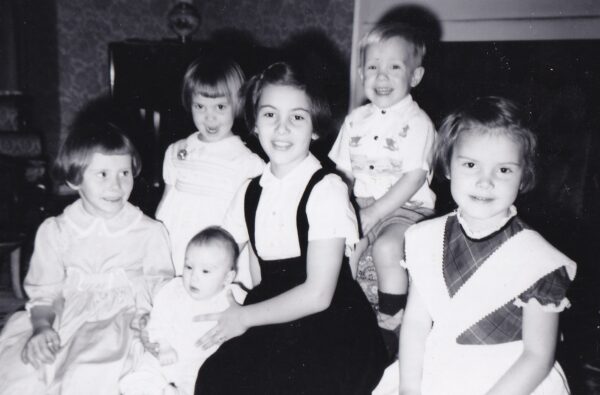
On Jan. 8, 1946, a birth notice appeared on page three of The Lindsay Daily Post, which read: “McGahey – On Sunday, January 6th, at Ross Memorial Hospital, Lindsay, to Mr. and Mrs. L. McGahey (née Leona Reeds), a daughter.” Bonnie McGahey was one of slightly more than 30 children born during that month who were recorded by the Town of Lindsay’s vital statistics department; some 42 births were recorded in the final month of 1945. These children were therefore among the earliest members of the Baby Boom generation to be born in what is now Kawartha Lakes.
The Baby Boom – with members of its cohort known colloquially as Boomers – encompassed a roughly 15-year timespan, running from the last few months of 1945 into the early 1960s. This period has been heavily documented in books, film, television, and other popular media – not to mention in the collective memory of those who lived it. As Canadian historian Doug Owram writes in his 1996 book, Born at the Right Time: A History of The Baby Boom Generation, “From the time the baby boom was born, it was extraordinarily powerful and, from a young age, it thought of itself as a group distinct from previous generations.” According to Owram, this can be explained in terms of its size, affluence, and the role it played in defining the youth culture of the 1960s.

And how did it play out in this community?
One of the first signs of things to come appeared on the same sheet of newsprint that announced Bonnie McGahey’s birth. An enormous quarter-page advertisement from Manley Motors bragged about the Nash 600, a huge new car that was then on display in Manley’s Wellington Street showroom. “Here Today! With tomorrow written all over it!” screamed the ad at its readers. Postwar prosperity saw a proliferation of bigger and ever more ostentatiously styled vehicles crowd onto local streets from the late 1940s into the 1950s; many Boomers can still recall in detail the make, model, and colour of the vehicle that sat in their family’s driveway while they were growing up.
Many of those driveways were situated in suburban neighbourhoods that emerged as a result of the rising birthrate – which in turn was directly influenced by returning veterans getting married, setting up a household, and starting families. As published in the July 2019 issue of the Advocate, municipal authorities concerned about a housing shortage made arrangements for the federally-funded Wartime Housing Ltd. to construct simple storey-and-a-half houses throughout Lindsay between 1946 and 1948. Other families moved into a brick bungalows where – if electricity was readily available – they could plug in fancy new appliances such as televisions and electric washing machines.
The local economy was thriving. New industries, such as American Brake Shoe Co., were building branch plants in Lindsay that would employ the young parents and parents-to-be of Boomers. Silverwood’s Dairy, which maintained a large facility at the corner of Kent Street and Victoria Avenue, published advertisements that capitalized on the importance of healthy childhood development: “Silverwood’s safe milk supplies in abundance the vital elements for the growth of every child – helps build strong, sturdy bodies,” one such ad assured new parents in 1946.
By 1951, when many of the first Baby Boomers were old enough to enter school, Premier Leslie Frost – and MPP for Victoria County – was proudly telling his province that “the many social and economic problems with which we have had to deal have been met and solved in accordance with our best Canadian traditions.” Things were only going to get better, an optimistic Frost implied.
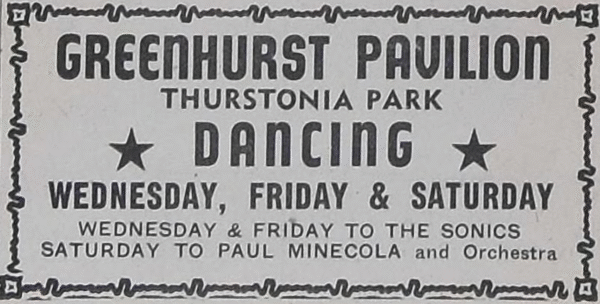
The Baby Boom continued along unabated, and as the Boomers became teenagers, they provided a steady stream of business for such enterprises as the Greenhurst dance pavilion on the southeast shore of Sturgeon Lake. “As teenagers we went to Greenhurst and danced on hot summer nights to the strains of Little Caesar and the Consuls,” recalls Linda Thomson, who was born in 1946 and grew up on Peel Street in Lindsay. “From the soda fountain downstairs, you could see the rafters actually moving up and down to the beat of the music,” she remembers of the pavilion.
Emblazoned with nostalgic Coca-Cola signage and echoing with the reverberation of rock and roll music, Greenhurst became something of a cultural touchstone for local Boomers. Today, memories of Greenhurst and other places, people, and events are regularly shared in a Facebook group calling itself “Lindsay and Area Reunion for Old Friends.” This group is aimed at sharing reminiscences among “people that grew up here when things were simple in the 40s, 50s, 60s, 70s and 80s.”
But were things really that simple?
In 1969, a little more than 20 years after the Baby Boom began, a critical article appeared in the pages of The Lindsay Daily Post, which pointed out that the massive population growth Canada experienced between 1946 and 1966 had several unintended consequences. “There wasn’t enough time to plan for growth,” noted the unnamed author of the story, “and we see the results today in polluted air, water, and soil, (and) in the haphazard urban sprawl which afflicts all Canadian cities.”
Eighty years after it began, the Baby Boom has left us with a memorable, albeit complex, legacy.



My sisters and brothers and I (5 kids in total) are baby boomers, and now all senior citizens. We too lived in the suburbs, first in Scarborough, then in Peterborough. The baby boom era was a great time to grow up in because of good, hard working parents who raised us in a time of prosperity. For me as a kid growing up, it truly was a wonderful time!
There were 4 Lambles born at RMH between 1940 and 1955. My brother George drown in 1961 at Pleasant Point, an odd name for a place with such bad memories for my family. My older brother Bill and me left Lindsay to seek our fame and fortune. My sister Lois stayed in Lindsay and died in 2020. I loved growing up in the east ward of Lindsay from he 40’s through 1969.
I hope other Boomers write on this site to tell us what happened to the etc in later life.