

Tariffs force Holsag’s closure in March of next year
Lindsay plant to close after 35 years
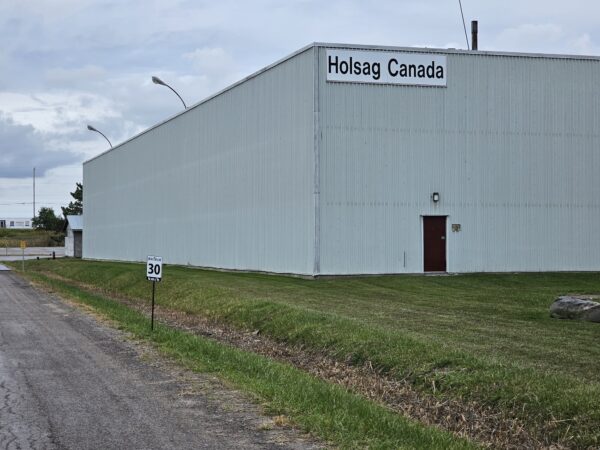
Holsag manufacturing is shutting down its Lindsay plant in March.
This comes after a plant wide meeting yesterday where it was announced the company’s furniture-making operations will be moving to Utah. The plant has been open since 1990 and has worked to serve customers across Canada and into the United States.

The CEO of the company visited from Utah to make the announcement.
“We had no idea he was coming up and he said that they’re moving our entire company from Canada to Utah,” said an employee of Holsag.
“We were all blindsided,” he said, noting that “people were crying, people were angry.”
The reason they were given for the shutdown was due to the rise of U.S. tariffs. “Twenty-give per cent tariffs are going up to 30 per cent, and they can’t afford that,” the employee said. The employee still works there at this time and would only speak after being granted anonymity.
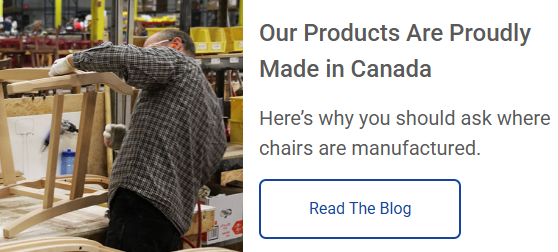
Employing approximately 130 employees, Holsag proudly describes itself on its website as a “trusted Ontario manufacturer.” This strong Canadian identity is part of the reason why employees are stunned by the company’s decision to relocate to the United States.
The employee said that the temporary workers have already been laid off, full time employees will be offered some sort of package, and part timers will not be receiving anything.
“We want to keep jobs in Lindsay,” the employee said, acknowledging that “a lot of families are going to be hurt.”
According to its website, it was originally founded as Holsag Europe in 1960. Holsag Canada has been operating a privately owned manufacturing plant in Lindsay, Ontario since 1990, sourcing wood from “the finest grown, and 100% sustainable, European Beechwood forests in Europe.”
The Advocate tried to speak with other employees of Holsag but no one was available for comment, we were told. After taking photos of the outside of the plant, the Advocate was asked to leave.
–with files from Roderick Benns.



The United States is waging Economic War on the world, via tariffs. It can do that because the United States is one of the largest economic markets in the world. There is no international trade body that can, in any real way, hold the United States or any large country accountable for trade issues. But you know that – it’s been the topic in the news for over a year.
Prior to the Free Trade agreement (FTA), later NAFTA and now CUSMA, Canada had a branch-plant economy and significant tariffs and a federal tax. These Canadian tariffs and tax protected Canadians by ensuring that many categories of goods had to be manufactured in Canada. Government procurement required high percentages of Canadian content, so American and European companies would open a plant in Canada to employ Canadians and bypass specific Canadian tariffs and taxes because their product was then made in
Canada.
Just as Russia is physically waging war on it neighbor Ukraine, the United States is waging economic war against its neighbor Canada and many other countries. Canada is in peril because of how deeply Canada integrated into the United States economically.
China and the US are also in a electronic war with Internet hacking and espionage being used to steal each others technology and trade secrets, which in turn boost their capability to build their economies.
1. Canada and Ontario must diversify it’s trading relationship to other countries.
2. The current US administration (Trump) has an expiry date of January 20, 2026.
As I write this, there are 1,189 days of waiting until the US administration will change. With that change, trade relations might be able to revert back.
The other option is the 51st State. For Ontario, and with an incredible reliance of manufacturing and steel and trade with the US, that’s looking like a better option with each passing plant closure in Ontario – Whether that’s Stellantis, or Holsag, or the next dozen plants closing that we dont yet know the name of.
States within the United States have considerable autonomy from the US Federal Government.
If Ontario were a U.S. state, it would rank approximately 5th in population and 4th in total GDP. However, because Ontario’s economy is weakened, its rank for GDP per capita would be much lower, potentially around 5th poorest.
Ontario as the 51st State would likely improve household income and wealth for Ontarians because Ontarians are far behind economically today.
This is a difficult decision in choosing the ability to have higher income and better economic prospects, ehile trading off the emotional attachment, history and patriotism of being a citizen of a specific country.
Remember – The boudaries and borders of a country are political geography.
The people in Niagara Falls New York are not that different than those in Niagara Falls Ontario. They are real people, with real families, dealing with the same real problems every day. We are simply aligned under two different political systems.
If Canada fails to diversify economically. If Canada fails to raise the income levels for Canadians. If Canada fails to produce a thriving independant Canadian economy, you cant have an independant Canada.
Can’t blame Holsag for the policies of a dictator in the US and 10 years of a federal liberal government in Canada. One day the people in the US will wake up hopefully and understand exactly what the maniac in Washington is all about and Canada will wake up and get rid of a government that could not care less about mfg jobs.
well we will have to boycott them
after they move
The POTUS loves the country he represents. Looks like the tariffs are doing exactly what he said they would do. Canadians can only imagine what it would be like to have a ‘leader’ who loves the country he represents. We haven’t had that for a decade.