
Remembering Indigenous military service
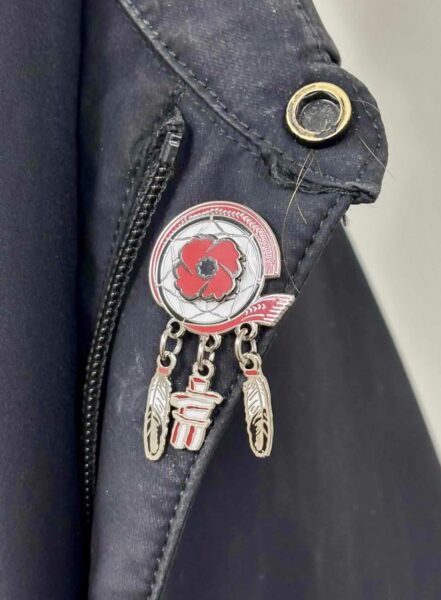
“Hey, I got you something!” Ward 8 Coun. Tracy Richardson tossed me a small package across the council table just before last Tuesday’s meeting.
I opened the bag and looked down at a shiny silver lapel pin: a red poppy on a dream catcher wrapped in a Métis sash, adorned with feathers and an Inukshuk – an Indigenous poppy.

This meant a lot to me, not just because of her thoughtfulness, but as a gesture of appreciation and respect recognizing the efforts and sacrifices of veterans from Indigenous communities.
Her act of kindness has inspired me to share more about Indigenous soldiers and their significant contributions.
Did you know, for example, that:
- more than 7,000 Canadian soldiers who volunteered to serve in the First World War and Second World War were Indigenous;
- Ojibwe soldier, Francis Pegahmagabow, became the most decorated Indigenous soldier in Canadian military history in WWI; and
- Métis corporal Henry “Ducky” Norwest was one of Canada’s most famous snipers.
Today, more than 2,800 Indigenous soldiers serve in the Canadian Armed Forces. Some 25 per cent of the Canadian Rangers – the “eyes and ears” of Canadian sovereignty in the North – are Indigenous.
We have always been here. We have always stepped up. We have always been – and are today – serving in the Canadian Armed Forces.
Indigenous poppies are available through the Royal Canadian Legion and local Indigenous vendors
“We will remember them.”
And marsee, Councillor Richardson!
–Mike Perry is a proud past member of the Canadian Armed Forces Reserves and a citizen of the Métis Nation of Ontario. He is councillor for Ward 3, Kawartha Lakes.



Well written Mr. Perry.
I am proud to have Mike Perry as a friend — for many good reasons!!
Thanks for raising awareness about the important contribution that indigenous soldiers have made. And also, thank you for reminding us that there are many different kinds of poppies out there, each of which reflect a sincere desire to honor and remember soldiers and civilians harmed in the course of armed conflict
Strong, proud and successful Indigenous Canadians like Councillor Perry do not fit the stereotype of the militant anti-Canada, land-back activist, so their stories are often suppressed and seldom heard in Canadian culture. But more and more Indigenous Canadians are fulfilling the legacy of Canada’s commitment to Truth and Reconciliation and working together as equals to build a strong and free Canada we can all be proud of.
Our local awareness of the contribution of Indigenous Canadians to our freedom, democracy, human rights and rule of law is a testament to our strong commitment to the truth that is necessary for reconciliation. Most of us around these parts have heard the story of Johnson Paudash, a Hiawatha First Nation WWI sniper from the Kawarthas. https://www.ricelakereserves.com/page12.html.
Some Canadian institutions have banned staff from wearing pins trademarked by the Royal Canadian Legion, such as the one Councillor Richardson gifted to Councillor Perry, claiming it can be seen as a statement of support for Canada and hence not impartial. But must we forget what we – Indigenous Canadians and immigrants and refugees – fought for, what we sacrificed our families’ youths for, to honour fairness, justice and equality today? Don’t our democratic values themselves depend on us holding high the torch of freedom thrown to us by long-dead veterans imploring us to take up the quarrel of injustice and tyranny with our foes, with those who would enslave us?
Canada is not perfect and goodness knows, there is no poverty of injustice in our system, but we have free elections, freedom of expression, due process, and a progressive, democratic rule of law that guarantees our human rights.
It was a lovely gesture of friendship for Councillor Richardson to gift Councillor Perry with the official Royal Canadian Legion lapel pin for Indigenous veterans. They can be purchased at the Legion Poppy store, here: https://www.poppystore.ca/lapel-pin-indigenous-veterans-600320?srsltid=AfmBOooIum9yNAY6VyCUKJ_0NPG0SetysMh2WfJTC_whqzosgGXZNlNV
The Indigenous poppy lapel pin Councillor Richardson gave to Councillor Perry is an official Royal Canadian Legion trademarked poppy. While the red poppy is the primary symbol of remembrance in Canada, other colours (such as white for peace, purple to remember animal victims, or black to remember specific conflicts) may be worn by some individuals, but they are not part of the official Legion campaign for the November Veterans Week/Day commemorations.