New immigrants in Kawartha Lakes face employment and belonging challenges
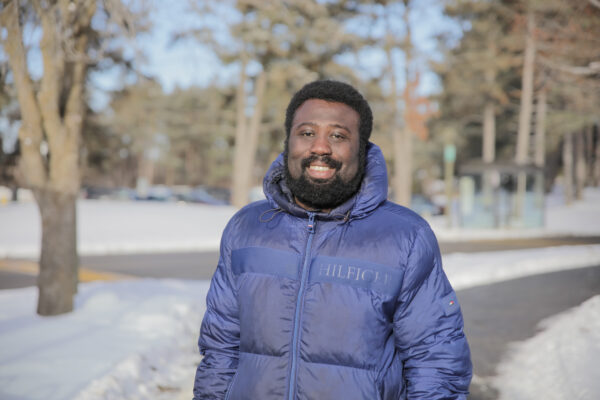
When Calvin Baalaboore immigrated to Lindsay from Ghana in 2024, he couldn’t help but feel lonely. With no established connections here and abilities that didn’t match up for Canadian jobs, he found it to be a difficult transition.
It would have been even harder without the support and services offered by Kawartha Lakes & Haliburton In-
tegrated Immigrant Services Association (KLHIISA).

Baalaboore came to Lindsay to obtain Fleming College’s postgraduate certificate in advanced water systems and operations management. While attending the program, he struggled to find part-time work. After nine months of living here, he had bills pil-
ing up, with no job to pay for them. That’s when he heard about KLHIISA.
“I sent an email explaining my situation to them, then they responded (and) we had a meeting where we discussed my goals,” Baalaboore said. From there KLHIISA was able to help him obtain his food handlers certificate which allowed him to finally gain employment.
Connecting new community members with job opportunities is one of the goals of the young organization.
Geraldine Silva, one of KLHIISA’s founders and directors, said that their job-matching program aims to benefit both the person looking for work and the employer.
“We will support them on the job for as long as it takes. If there’s any issue with the employment, the employer can reach out to us. We are making it clear that immigrants are among the hardest working, most committed employees that you can find.”
Silva herself immigrated to Canada in 2010, and only recently came to Kawartha Lakes but she saw a need to have the support available to make the transition into a new city smoother.
“Almost every newcomer or immigrant that we’ve come across here needs community connections, one way or the other. It could be that they need information. It could be that they need services from other service providers.”
KLHIISA has been expanding its services by working with other organizations to help newcomers access any supports they may need. “Now we have community partners who we can refer our (new) community members to go see a doctor,” Silva said, as one example.
“Some immigrants have life threatening conditions or have ongoing health issues. So, we can make the connection to service providers who can help someone get medication,” said Silva, noting her organization isn’t the one paying for prescriptions. Physiotherapy services may soon be included as well.
Organizations and community members offering up their services is just as important as receiving financial support, according to Silva. If companies are willing to hire immigrants or are able to help provide a service for new residents, she said it’s all beneficial.
KLHIISA is also working closely with Ampere. Jamie Steel, senior lead of community relations at the non-profit, said they are an organization that is excited to learn and grow by listening to what newcomers need and want in the community – and then making it happen. “We’re working with (KLHIISA) to make sure that what we offer is actually helpful to the people that need it,” Steel said.
Ampere currently offers programs for both adults and youth. “There are live workshops that happen either in person or virtually, and they walk you through and teach you digital skills in whatever capacity,” said Steel. These workshops range from teaching someone how to use email to more advanced skills like social media marketing for a small business.
For kids, Ampere offers a lot of STEAM programs, with drop-in sessions that allow youth to follow their passions. “It doesn’t matter if you’ve lived in Lindsay for a month. It doesn’t matter if you’ve lived here all your life. You walk in and you can grab a robot, you can start playing on the laptops or tablets that they have set up you. It’s an equal learning space,” Steel said.
The hope, says Steel, is to ensure the services they offer are in line with what newcomers need. “What (KLHIISA) offer
this community is invaluable, and if we can play a small role in amplifying that work…that’s exciting to me,” she said, with Ampere having a goal of building a stronger sense of belonging in the community in 2026.
Baalaboore has now applied for a graduate work permit and is looking for a full-time job in Lindsay.
Dharmik Shah, one of KLHIISA’s directors, came to Kawartha Lakes from India in 2017, has found that there’s a misconception that newcomers are trying to take jobs from residents who have lived in Kawartha Lakes their entire lives. “We are not here to take from the community, but we are here to add value.”
At the end of the day all they want is for “newcomers to feel welcome, supported, and we want them to be successful,” said Shah.
Bita Talebi, one of KLHIISA’s directors, immigrated to Canada in 2022 from Iran as a student and hopes that the organization will help not only Baalaboore but many others as well. “In my experience, so many sets of skills that are required are different than mine, than in my country,” she said.
For example, in Iran volunteering wasn’t a common thing, but when she attended Fleming College, many students would spend their free time volunteering. She learned that giving your time to help is a way to interact with others and to be a contributing member of the community.
This idea of interacting with others and being a member of the community is another important aspect of KLHIISA, as their hope is to allow new residents to make strong and lasting connections.
For Baalaboore, he was able to make some connections by attending church, and once his classes started at Fleming, he was able to establish friendships. However, he observed that he is often the only person of colour in a room.
“One thing that I found a bit difficult for me was I noticed I was the only Black person in most places. I (would) go to the restaurant with my friends, my white friends, and then I’m the only Black person there. So, it felt a bit awkward,” he said.
That feeling of being the ‘other’ in a room isn’t uncommon for newcomers in the area. KLHIISA offers invitations to events and activities in the community to help new members be able to make those connections, and not only meet longtime residents of the area, but to also meet other newcomers.
Talebi said the best part about KLHIISA, is that it’s a resource for all newcomers. Regardless of where they’re from, their gender, race, or religion, the goal is simply to allow all community members in Kawartha Lakes to feel welcome.
She was shocked when she had the opportunity to meet community members who had settled in Kawartha Lakes from across the world. Talebi said that without KLHIISA she wouldn’t have had the opportunity to learn about so many other cultures.
With a population that is continuing to grow, Silva is hopeful that KLHIISA can be a hub where new community members can continue to turn. “It’s all about giving immigrants a chance, welcoming immigrants, community integration for immigrants and newcomers.”
As for Baalaboore, his hunt for a full-time job continues, but he is very grateful that KLHIISA has been able to help him develop his skills and integrate into the community. “KLHIISA is a very good organization, and I urge new immigrants who are having trouble assimilating to contact them.”
For more information about KLHIISA go to klhiisa.org.