

Citizen says local residents are worried about federal radar program
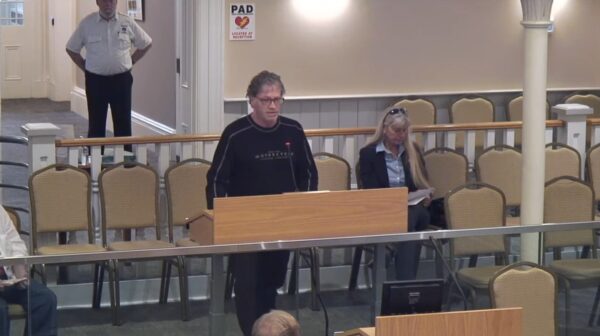
A Kawartha Lakes resident delivered a deputation to council raising concerns about the proposed Department of National Defence Arctic Over-the-Horizon Radar Program, particularly its proximity to local residents.
Addressing council during the May 5 committee of the whole meeting, David Strickland urged that the 163-hectare property at Thistle Trail, west of County Road 41, not be sold to the DND.

Strickland cited three main concerns about using this land as a radar defence site: potential danger to families living in the area, the loss of rural sanctuary and what he described as residents being “left in the dark” about the project.
The Arctic Over-the-Horizon Radar Program is a major defence initiative aimed at strengthening Canada’s ability to detect and monitor potential airborne threats at long distances. It forms part of a broader modernization of the North American Aerospace Defence Command, a joint Canada-U.S. system responsible for aerospace warning and control.
The Thistle Trail site is one of four locations being developed as part of the project and was selected due to its flat, dry landscape and proximity to electrical infrastructure.
Strickland said he and other residents, including 47 who signed a petition opposing the land sale, are concerned about safety risks if the site were ever targeted.
“We are talking about the ultimate price the people living next to this site would pay if it becomes a possible military target,” he told council. “Placing a military radar site in a known location is a focused target, and in any conflict or violent rupture, collateral damage is now a certainty.”
Strickland noted how one resident in the area, a mother with four young children, recently built a home near the site.
“(The government) is putting her family inside of a target zone,” he said.
Following Strickland’s address, council members asked no questions and unanimously voted to receive the deputation.



While it is natural to feel uneasy about new military infrastructure, we should view this radar project as a vital shield, not just a target. If the Arctic Over-the-Horizon Radar works as intended, it provides the early warning necessary to detect and neutralize threats before they ever reach Canadian soil. Without this “eye in the sky,” we are all vulnerable; with it, we are providing security for the entire country, including Kawartha Lakes.
However, if our community is going to be a “willing host” for a project of such immense national importance, the federal government needs to step up as a partner. Kawartha Lakes is providing the ground to protect the nation, and in return, the feds should invest in our local future.
I would propose that the Feds should invest in the host community by closing the funding gap for the Summit Wellness Centre, the new Medical Center in Coboconk. The Feds could further invest in the Coboconk Fire and Emergency Services which need a new fire station, and could benefit from training investment, including training on how to respond to emergencies at the radar installation.
The key in Community Benefits is to positon them as dual-use, and improvement to the radar installation and its personel as well as a benefit to the community. It’s also critical to position it as annual recurring funding and not one-time grant money. All local services are starving for recurring funding.
Let’s turn this into a win-win: national security for Canada, and essential health and safety infrastructure for the people of Kawartha Lakes. It’s time to ask Ottawa for a community benefit agreement that reflects the value of the land and the cooperation Kawartha Lakes are providing with this over the horizon radar in our community.
“a vital shield”
do you mean, in a war that Canada seems on track to blindly follow its partners into, beyond boostering for the Ukraine travesty?
“If […] works as intended […] before they ever reach Canadian soil”
How? Is Cdn soil not the Arctic? The range as far as is disclosed does not seem to reach e.g. Russia. And once a hypersonic is on the way, do you really think this detector is of much use, even if detectable that far away?
” closing the funding gap for the Summit Wellness Centre”
Yeah, I like it, kinda seconding what I say below, if for a diff. reason – more sickness induced, more facility needed, sure.
” a win-win”
Yep again – save billions for dnd in not choosing a more sensible site on creaturely vs technical & cost grounds, and more $ for meds to care for prospectively injured by the very radar!
RE: “Is Cdn soil not the Arctic? The range as far as is disclosed does not seem to reach e.g. Russia”
Because Over-The-Horizon (OTH) radar can see thousands of kilometers beyond a country’s borders, it provides massive early-warning capabilities. If an intercontinental ballistic missile (ICBM) or a hypersonic cruise missile were launched from across the ocean or the Arctic, an OTH system would detect the threat long before the missile ever reached Canadian airspace.
Why Southern Ontario instead of the Arctic?
While the radar is designed to stare deep into Canada’s northern approaches and the Arctic circle to spot incoming threats from adversarial nations, the physics of OTH require it to be placed further south. If the antennas were built in the Arctic, the radar signals would have to pass through the “auroral zone” (where the Northern Lights happen). The intense geomagnetic activity of the Northern Lights interferes with and scrambles the radar waves. By placing the transmitters in Kawartha Lakes, the radar can cleanly bounce its signals off the stable ionosphere of mid-latitude Canada, casting a massive surveillance net deep into the Arctic and well beyond Canada’s northern borders.
Radio Frequency Energy Safety:
Because the transmitter site is pushing out a lot of power to bounce those radio waves off the ionosphere, there is a localized area directly in front of the antennas where the energy is too high for humans. DND stated that they are managing this using strict protocols:
The Fence Line Buffer: The DND has purchased a large 163-hectare (approx. 403-acre) plot of land. The actual high-power transmission area will be restricted. DND states that any hazardous electromagnetic zones will be entirely contained within the perimeter fencing. Beyond the fence line, the radio frequency levels drop to completely safe background levels.
Safety Code 6: The site must strictly comply with Health Canada’s Safety Code 6, which sets some of the strictest limits in the world for human exposure to electromagnetic fields.
Airspace Restrictions: Because the radar beams shoot upward into the sky, the government is working with aviation authorities to establish flight restrictions directly over the transmitter site. This ensures that passengers and pilots in low-flying aircraft are not exposed to elevated waves.
I’m an electronic engineer by training and have been working with radio frequency emitting equipment throughout my career. First with 800 Mhz cell tower signals in the 1990’s, 1.9 GHz microwave and in recent years ever higher frequencies.
The type of signals emitted by the Over Horizon Radar are more like AM radio transmission, low in frequency, but high in power. It’s about as dangerous as driving by the old CKLY AM radio towers on Hwy 35. ie: Not dangerous, not even concerning.
On the frequency spectrum the OTH radar will use HF or High Frequency radio energy which exist just above the old AM radio band, and below Channel 2 on your TV.
The Waves Shoot Up, Not At You. The OTH radar doesn’t sweep across the ground like a movie radar. Its giant antenna arrays are electronically angled (phased) to blast their energy straight up into the sky. The target isn’t the local town; the target is the ionosphere (a layer of the atmosphere about 90 to 300km above the Earth). The signals bounce off this layer like a mirror to look over the horizon, entirely overshooting the people living nearby and keeping an eye on Russia, and maritime threats from our Artic waters – for example a submarine launched missile from the northwest passage.
I cant tell you to not be afraid, because my simple words are unlikely to satisfy your distrust any more than a dozen publications on safety from the DND have not.
I’m an electronics engineer, I’ve worked with a lot of radio equipment during my career and I personally have no concerns about the DND technical proposal and that it will be safe for humans and animals outside the fenced area.
I worry that Canada has not been investing in protective and defensive military systems like this OTH Radar, and with an expansionist Russia, an angry Iran and a loose cannon running North Korea, Canada is already positioned between those countries and the United States regarding an over the pole kinetic attack. Whether Canada donated to Ukraine or not does not change the calculus on our relative safety.
I do not think you have the specs right on your claim. Is it est 3000 km reach? Well within Cdn airspace, no? Also, what use vs a hypersonic missile or the newest extreme one now advertised as hyper-deterrent by the apparent constant target of Western belligerence, by proxy (currently using Ukraine) or directly hot as seems to be a brewing intent, ie vs Russia? In Oz i think theirs (situated nothing like close to where people are as here) is mainly used to watch maritime traffic. Fair enough that better surveillance of Cdn Arctic traffic incl military coordination might be needed, but no excuse to put it here when it can go I think a whole latitude line north where far fewer live, not to mention Cape Rich – let DND come clean with the reasons they chose, instead of saying as one supposedly in charge said, she did her best. Even enhanced range of what 1000km more would be of little use re such missiles or even drone swarms. Seems like the huge expenditure is meant to pad out toward the 5% NATO thing. But savings had for easy terrain on the alvar.
” radar can cleanly bounce”
Again, it ain’t simply so What about e.g. winter weather? Anyway I think eg US & Brazil locate theirs more sensibly by the seas aimed outward, not close to people’s heads. Oz’s way out in the wilds.
“well beyond Canada’s northern borders” – how do you figure this?
“hazardous electromagnetic zones will be entirely contained within ” – uninstructively the copious commentary on topic at the links provided must have not been read, why not try to address that?
“some of the strictest limits” – ditto…the basis of the code is long proven wholly irrelevant to health
“Not dangerous, not even concerning.” – time to read up on the sci & other lit i mentioned, why not try?
So cleaning out old printed material just now (inter alia finding some letters to the editor that this publication printed back when), I come across material that completely rebuts Mr Neals’s claim, “Health Canada’s Safety Code 6, which sets some of the strictest limits in the world for human exposure to electromagnetic fields “.
I think little has changed from when the now late premier lay researcher into these topics, Arthur Firstenberg, whose important book, Invisible Rainbow, should be yet available via both CKL & Haliburton libraries; AF put out a chart already in 2001, displaying power densities acceptable in various countries’ guidelines for human exposure, in relation to power densities at which researched symptoms have been found.
Canada is near the most permissive top of the list in the 1000 microW/cm2 (eg Australia close to 10x lower allowable, China & Italy close to 100x lower threshold of safety, Russia & Switz. close to 1000x; UK est. 10x more permissive). You see these are all over the map, obviously demonstrating that “authorities” are at sea in all this, plus under extreme pressure from industry, abettors, military et al to put out nothing that will go against that pressure.
All the guidelines furthermore are thus PURPORTED safety levels, but against which a massive sci lit already existed by 2001 to contradict the entire basis of these national limits. (Even in Canada in 1973 a warning was put out by a group of NRC researchers…and Motorola launched its cell phone project that very year…) From that sci lit AF’s chart indicates impaired memory & visual reaction times at 100x below Canada’s “safety”limits; tinnitus, headache, dizziness, fatigue, weakness, insomnia found at levels est. 1000x lower; blood cell alteration, decreased cell growth, leukemia 1000 to 10000x lower; sleep disorders, weakness, pain, fatigue est. 100,000 to 1,000,000x lower; and even at 10 trillion x lower EEG alteration found.
Since 2001? Have a good browse for example of the important Bioinitiative Report for a good overview with possibility to delve into particulars of sci lit that deliberately escapes influence on your “authorities”.
Locating radar with plentiful spillage right over and atop citizens’ heads is plainly wrong. Not to mention the rest of it virtually everyone acquiesces in.
See the many informative comments after a prior topical article in this publication,
https://lindsayadvocate.ca/kawartha-lakes-radar-project-sparks-questions-over-safety-environment-and-transparency/
.
The presenter to council misses the primary point both re opposition and what local council might do, despite the mayor’s erroneous completely begging off challenge possibility by the municipality. Of course there are many oppositional points, such as mentioned at the comments at the link above. But health jurisdiction is provincial and local. Mere apprehension of health threat is, as held by one QC court in a case re cell tower siting, sufficient basis for municipal action, such as to alter or forbid certain locations of telecommunications equipment even as the latter are governed federally (further with DND exemptions albeit, which risk confounding the case; see mention again at link above).
Alas a principal affected region would be Head and Rush Lakes just to the north of the proposed site. The previous mayor was sadly a booster for what has finally come to pass, in this (& many a) low population density area – a proliferation of cell towers has occurred in the last two years or so. This used to be a most welcome relatively low rad refuge. No longer. Govt subsidy as lobbied for by the EORN has brought health danger. (How’ll ya call 9-1-1 on rte 45 when ya needs it – now that calls won’t be dropped for what ailment’s induced by the very antennae takin’ yer calls!)
If one held one’s breath, alas again, for as long as it would take this or any typical Ontario council to move on this REAL health danger, towers, radar ‘n’ all (the sci and other lit on which is enormous, yet still escaping general populace for the most part, if less and less so)…I guess the reliable cell calling ‘ll be of use…
A few other salient remarks after another piece of some months back in this mag/paper as well:
https://lindsayadvocate.ca/council-throws-shade-on-two-large-solar-farm-projects/