
By the time a Kawartha Lakes voter chooses one name for mayor this October, four other names may already have been eliminated in their mind.
One candidate may have been ruled out over taxes, another over roads or development. Municipal experience may matter most to one voter, while another may put more weight on governing style, local priorities or a desire for change. Long before the ballot is cast, five candidates may have become three, or perhaps two.
Ron Ashmore, Mathew Flynn, Doug Ford, David Korn and Charles McDonald are the five certified candidates for mayor. Voting begins at 9 a.m. Oct. 16 and closes at 8 p.m. Oct. 26.
The mechanics are straightforward. The psychology behind the choice is more complicated.
The first cut
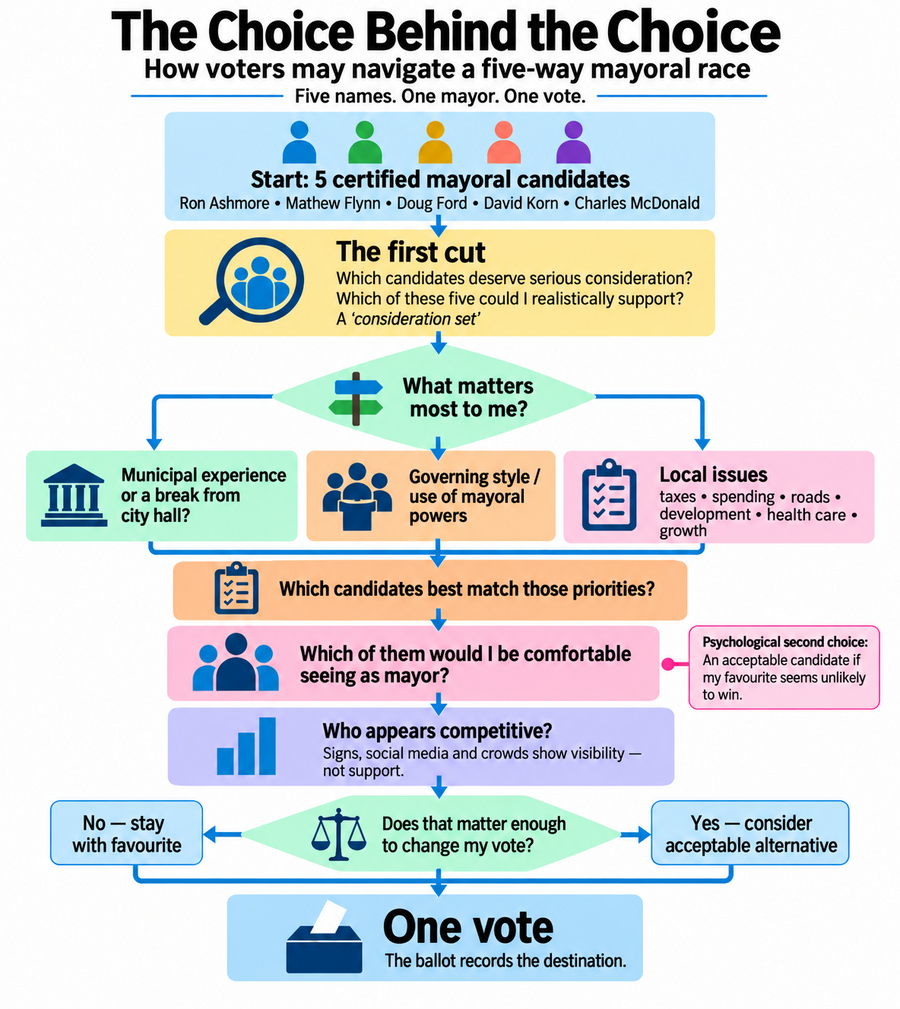
Political scientists have a term for one way people simplify a crowded electoral choice: the “consideration set.”
Rather than weighing every candidate equally until voting day, a voter may first decide which candidates are worthy of serious consideration and eliminate those they are unlikely to support. The final decision is then made from the smaller group that remains.
In a five-person race, the idea is easy to understand. A voter may not begin by asking, “Which of these five people is my perfect candidate?” The more practical question may be, “Which of these five could I realistically support?”
That first cut could happen for many reasons. Taxes and municipal spending may dominate for some residents, while others may focus on roads, development, health care or growth.
Experience provides another obvious dividing line. Ashmore represents Ward 6 on council and McDonald represents Ward 7. Flynn, Ford and Korn are not members of the current council.
One voter may see municipal experience as useful preparation for the mayor’s office. Another may see a candidate from outside the current council as offering a greater break from the existing direction of city hall.
Either way, five candidates can quickly become a much shorter personal list.
A different mayoralty
This election also comes with an institutional change voters did not face the last time they chose a mayor.
Kawartha Lakes received Ontario’s strong mayor powers effective Nov. 1, 2023. The framework gives the mayor added authority in areas including the chief administrative officer, certain senior staffing and organizational decisions, the municipal budget, some council committees and written direction to municipal staff.
That does not tell voters what qualities they should value, but it does mean the office being filled in 2026 is different from the one residents voted on in 2022.
For some voters, that may make municipal experience more important. Others may put more weight on governing style, judgment or how a candidate is likely to use the powers of the office.
The second choice that is not on the ballot
Kawartha Lakes voters do not rank candidates for mayor. They select one, and the candidate with the most votes is elected.
But voters can still carry an unofficial ranking in their heads.
There may be a favourite. There may also be another candidate they could comfortably support, along with others they have already ruled out.
That psychological second choice becomes more interesting when another question enters the calculation: Who can actually win?
Imagine a voter who prefers Candidate A but would also be comfortable with Candidate B. If that voter comes to believe A has little chance of finishing first while B appears competitive, the decision may change.
Do they stay with their favourite, or support the acceptable alternative?
Political scientists generally describe the second behaviour as strategic or tactical voting.
Canadian research has found evidence of strategic voting in plurality elections, but it has also found many voters remain with their preferred candidate even when a tactical alternative exists. Much of that research comes from federal or provincial party politics, so it helps explain the psychology but cannot tell us how Kawartha Lakes residents will vote.
Who is actually competitive?
Strategic voting also creates a practical problem.
Before voters can react to who appears capable of winning, they need some basis for deciding who is competitive.
That may be easier said than done.
One candidate may seem prominent because lawn signs are everywhere. Another may attract a large crowd. Someone may appear frequently in a voter’s social-media feed, while another may simply be the name friends and neighbours mention most often.
Those things can show visibility, organization or enthusiasm. They do not necessarily measure support across the electorate.
A forest of campaign signs is not a scientific poll. Neither is Facebook.
Without reliable polling, voters trying to judge who is viable may be relying largely on impressions. That creates an unusual loop: some voters may make decisions partly on who they think other people will support, while those other people may be trying to make exactly the same calculation.
Who appears to be leading and who is actually leading are not necessarily the same thing.
A crowded race is nothing new
Kawartha Lakes has seen this kind of electoral math before.
Six candidates ran for mayor in 2022. Doug Elmslie was elected with 7,982 votes, or 35.27 per cent of votes cast for mayoral candidates. Pat Dunn received 23.40 per cent and Kathleen Seymour-Fagan received 17.45 per cent, with the remaining votes divided among three other candidates.
Overall voter turnout was 32.66 per cent.
Those figures do not predict the 2026 result. They simply illustrate how a plurality contest works: a candidate does not need more than half the votes to finish first.
In 2022, nearly 65 per cent of mayoral candidate votes went to people other than the person who was elected.
That helps explain why a candidate’s broader acceptability may matter alongside the number of residents who consider that person their first choice.
The usual campaign question is: How many voters most want Candidate A?
In a crowded race, another question may matter too: How many voters who prefer somebody else would still be comfortable with Candidate A?
Official election results answer the first question. They never answer the second.
The decision before the decision
Even the ballot leaves some information out. Kawartha Lakes says incumbent status will not be identified, and candidate names will be listed alphabetically by surname.
A voter who already knows Ashmore and McDonald are sitting councillors brings that information to the ballot. Someone who does not know will not learn it there.
Two residents can therefore look at exactly the same five names while bringing very different amounts of information to the choice.
For some Kawartha Lakes voters, choosing the next mayor may ultimately involve a series of questions: Which candidates deserve serious consideration? What matters most to me? Which candidates best match those priorities? Which of them would I be comfortable seeing as mayor? Does my preferred candidate appear competitive? And, if not, does that matter enough to change my vote?
Other residents may have settled on a candidate long before voting begins and have no intention of reconsidering.
Both routes end at the same place: one vote.
When voting closes Oct. 26, the official results will tell us exactly how many votes Ashmore, Flynn, Ford, Korn and McDonald received. They will tell us who became mayor.
They will not tell us who voters almost supported, which candidates were eliminated first, which issues changed minds or how many residents considered switching but stayed with their favourite.
The ballot records the destination.
The more complicated story is how each voter gets there.



Leave a Comment
Your email address will not be published. Comments are moderated.