
There's a familiar complaint across Kawartha Lakes, particularly outside Lindsay: when it comes to choosing a mayor, Lindsay decides for everyone else.
It's an understandable view, and what I wanted to explore with this analysis. Lindsay is the municipality's largest urban centre, while the rest of Kawartha Lakes includes smaller towns, villages, waterfront communities and farmland, each with its own priorities.
But results from the last two municipal elections tell a more complicated story. Lindsay carries considerable electoral weight, yet in neither election did its two wards change which candidate finished first across the municipality.
Lindsay delivered the margin
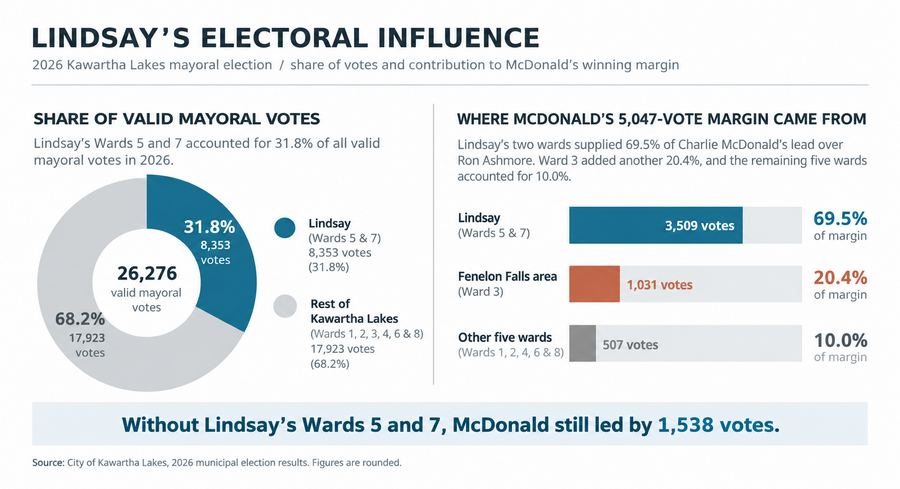
Mayor-elect Charlie McDonald finished first in the Oct. 26 election with 13,542 votes, or 51.5 per cent of valid mayoral votes. Ron Ashmore, the outgoing Ward 6 councillor, finished second with 8,495.
Lindsay's two wards played an enormous role. McDonald led Ashmore by 1,753 votes in Ward 5 and 1,756 in Ward 7. Together, they gave him a 3,509-vote advantage — about 70 per cent of his citywide margin of 5,047 votes.
That's striking considering Lindsay's two wards accounted for only about 32 per cent of valid mayoral votes.
But Lindsay wasn't alone. There may be a new political alignment emerging along Highway 35.
Ward 3, which includes Fenelon Falls, gave McDonald another 1,031-vote advantage. Combined, Wards 3, 5 and 7 accounted for 4,540 votes of his winning margin — about 90 per cent.
Remove Lindsay's Wards 5 and 7 entirely, and McDonald still finishes first, with 8,167 votes compared with Ashmore's 6,629.
Even removing Ward 3 along with the two Lindsay wards leaves McDonald ahead, 6,276 votes to 5,769.
Lindsay didn't change who finished first. It made the victory more decisive.
A majority in only half the wards
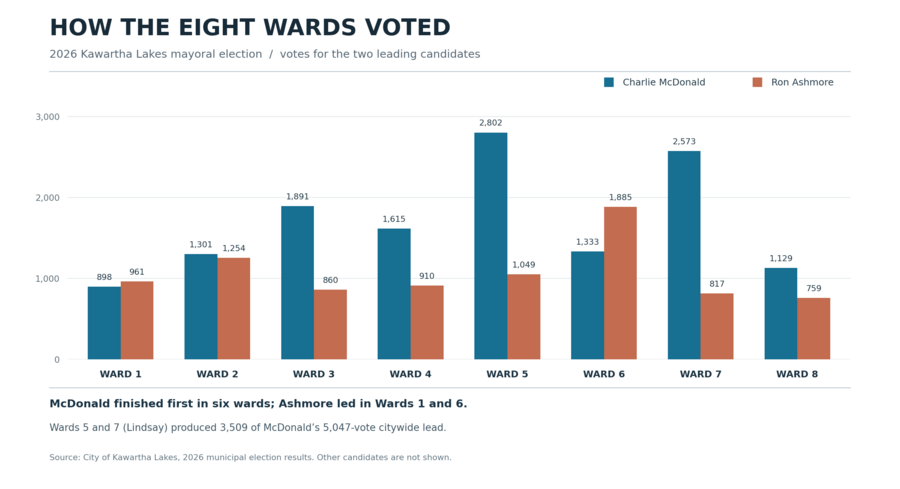
McDonald finished first in six of eight wards but received an outright majority in only four.
His strongest showing came in Ward 7, where he received about 66 per cent of valid mayoral votes. He captured about 63 per cent in Ward 5, 58 per cent in Ward 3 and 52 per cent in Ward 4.
Elsewhere, the contest was closer.
In Ward 8, McDonald finished first with about 49 per cent. In Ward 2, which includes Bobcaygeon, he received about 42 per cent, finishing just 47 votes ahead of Ashmore.
Ashmore carried Ward 1 with about 39 per cent and his home Ward 6 with about 52 per cent.
Across the six wards outside Lindsay, McDonald received about 46 per cent of valid mayoral votes. Most voters there supported other candidates, even though McDonald finished ahead of each individual opponent.
Both leading candidates attracted strong support in the wards they previously represented. McDonald, the outgoing Ward 7 councillor, received his strongest support there, while Ashmore performed best in Ward 6.
But McDonald's commanding margin in Ward 5 shows his Lindsay support extended beyond his former council ward.
The pattern isn't new
The 2022 election tells a similar story.
That year, Doug Elmslie won a six-candidate mayoral race with 7,982 votes, defeating runner-up Pat Dunn by 2,687 votes.
Lindsay's Wards 5 and 7 accounted for about half that margin. Remove those wards and Elmslie still finishes ahead by 1,367 votes.
Elmslie had represented Ward 3, which includes Fenelon Falls, rather than Lindsay. His strong showing in Lindsay suggests voters there were willing to support a candidate from outside their own community.
In both elections, Lindsay substantially increased the winning candidate's margin. But removing its two wards wouldn't have changed who finished first.
Two elections aren't enough to establish a long-term trend. The closer 2018 election, when Andy Letham defeated Gord James by 1,557 votes, remains worth examining.
Who turned out to vote?
Lindsay's two wards accounted for about 31 per cent of ballots cast in the 2026 municipal election, giving the municipality's largest urban centre considerable electoral weight.
But that doesn't necessarily mean Lindsay residents were more likely to vote than people elsewhere in Kawartha Lakes.
The city has published the number of ballots cast in each ward, but not the eligible-elector counts needed to calculate ward-level turnout.
Across Kawartha Lakes, 27,170 people voted, an increase of more than 4,000 from the 2022 election.
The results show Lindsay's substantial contribution to the vote, but whether its residents participated at a higher rate than those in other wards remains unanswered.
Different wards, different concerns
The campaign priorities of newly elected councillors offer another perspective on the mayoral voting patterns.
In three of McDonald's strongest wards — 3, 5 and 7 — councillors Mike Perry, Mark Doble and Eric Smeaton discussed managing growth and development.
Those concerns also featured in McDonald's campaign, including his pledge that development should not proceed without adequate water and sewer capacity.
In several wards where Ashmore attracted stronger support, the emphasis was different.
In Wards 1, 2 and 6, newly elected councillors Brian Bartley, Terry Blackmore and Jasmine Marshall campaigned on ensuring their communities receive adequate municipal attention and resources.
Bartley's platform argued that Ward 1 residents pay urban tax rates while receiving rural services. Blackmore said many residents in northern Ward 2 feel forgotten and inadequately represented. Marshall promised to push for a line-by-line review of what Ward 6 receives for its share of municipal spending.
All three expressed concern about the pace of tax increases. Marshall went further, pledging to oppose increases above inflation.
Campaign platforms aren't voter surveys, and the results don't establish why individual residents voted as they did. Many of the same issues also matter across ward boundaries.
Still, the differences raise questions about whether residents in different parts of Kawartha Lakes feel equally represented.
Is Fenelon Falls moving closer to Lindsay?
Ward 3's strong support for McDonald raises another question: Are Lindsay and Fenelon Falls developing shared political priorities as their communities become more closely connected?
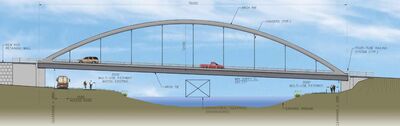
Both communities are experiencing growth and facing similar challenges involving development, roads and municipal infrastructure. Fenelon Falls has concerns about sewer capacity and its bridge crossing, while Lindsay faces its own pressures from development and infrastructure demands.
But shared challenges don't necessarily translate into shared political preferences, and the historical election results offer a more complicated picture.
In 2022, Elmslie received about 39 per cent of valid mayoral votes in his former Ward 3. He attracted stronger support in Lindsay, receiving about 43 per cent in Ward 5 and 40 per cent in Ward 7. Ward 3 also recorded the municipality's highest turnout that year.
The 2026 results may suggest closer political ties between Lindsay and Fenelon Falls. They could also reflect the particular candidates and circumstances of this election.
More than one election will be needed to determine whether this budding political relationship along Highway 35 is just a one-election fling or the beginning of a lasting political marriage.
So, does Lindsay decide?
Not in the last two mayoral elections.
Lindsay didn't overturn the preference expressed across the other six wards. It made that preference more emphatic.
McDonald has promised "visible improvements in every ward." That commitment will matter particularly in communities where his support was weaker and where newly elected councillors have emphasized taxation, infrastructure and fair representation.
The bigger question may not be who chooses the mayor, but whether residents throughout Kawartha Lakes feel heard once the votes are counted.
And with roughly two-thirds of eligible electors not voting, despite the availability of online and telephone voting, what will it take to persuade more residents to participate?

Leave a Comment
Your email address will not be published. Comments are moderated.