
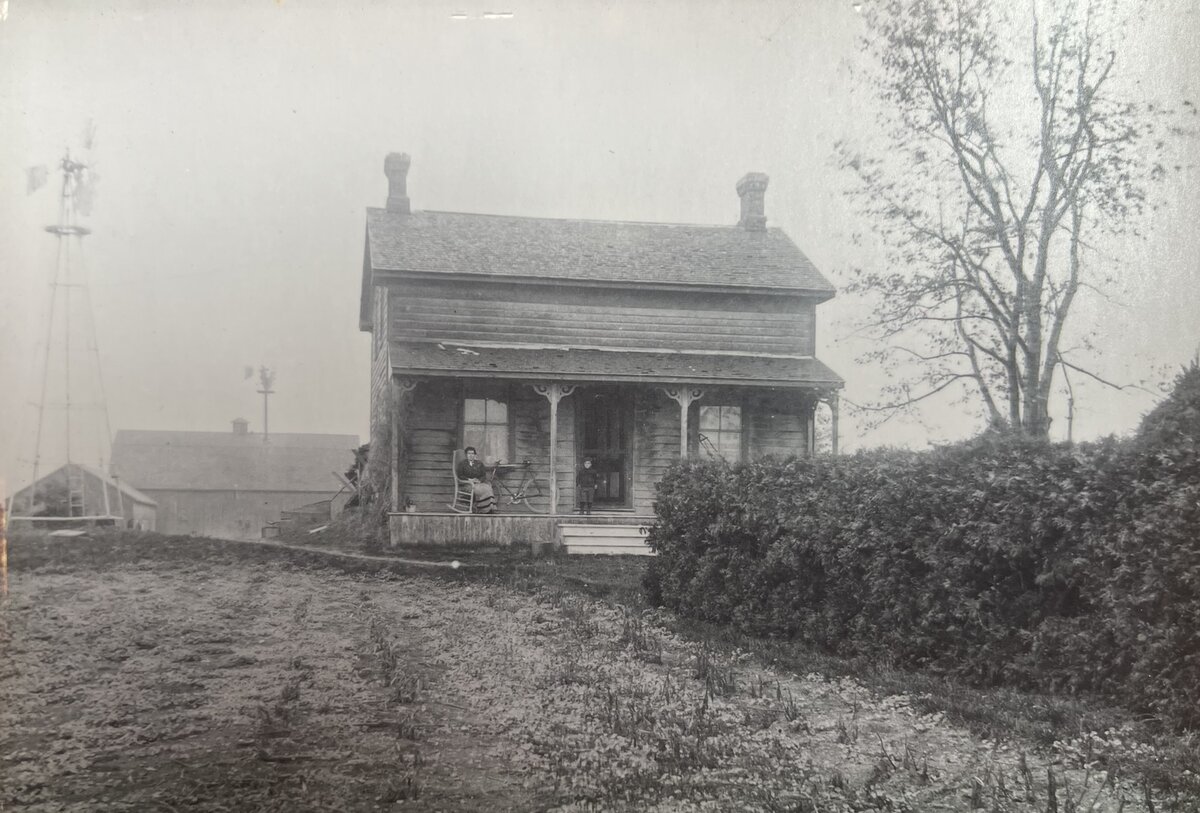
Sometimes, the most meaningful stories begin with an unexpected connection. For Richard Jenkins, whose family roots in Kawartha Lakes stretch back more than a century, a chance encounter with an old acquaintance became the starting point for sharing generations of family history. It was also a reminder that, despite the vast geographical area of Kawartha Lakes, our communities are often more closely connected than we realize.
My introduction to Richard’s family history began during a visit with Reid Torrey at his home. As circumstances would have it, Richard and Reid reconnected, and Richard immediately recognized Reid from his childhood in Oakwood with, “Are you Reid Torrey?!” As a young boy, Richard worked at the Oakwood Store, owned by Blake and Cheryl Drinkwalter, where Reid regularly travelled from Eldon Township to sell potatoes grown on the Torrey family farm. Having previously shared Reid’s family history in Kawartha Lakes Moments and Memories, it was a delightful coincidence to discover this connection between two families whose stories are so deeply rooted in the region.
Following this chance meeting, Richard and I spoke at length about his family’s roots in Kawartha Lakes and memories of growing up in Oakwood. What began as a casual conversation revealed a larger story of connections between people, places, and families. Not long afterward, we sat down for a more in-depth conversation, allowing the rich history of the Jenkins family to unfold.
The Jenkins family’s story begins in Devon, England, on Dec. 29, 1846, when James Jenkins, a farmer, married Frances ‘Fanny’ Beer, daughter of John Beer and Ann Wood, at the Milton Damerel Methodist Church.
Tragically, Fanny lost her life in a horse-and-buggy accident at age 53. James later married Rebecca Horn, before passing away in 1882. Despite these hardships, 10 of the Jenkins children survived into adulthood, with seven venturing across the Atlantic in search of new opportunities, six of which settled in Ontario, and two of the six beginning a chapter that would leave a lasting legacy in Kawartha Lakes.
James was the first of the Jenkins children to arrive in Canada in 1870, initially renting farmland in St. Thomas before purchasing a farm near Belmont, Ontario. Now known for their Holstein cows, Monoak Farms is still in the Jenkins family five generations on.
Several years later, eldest son Joseph travelled with his siblings John and Jennie aboard The Sarmatian. They departed from Liverpool and arrived in Quebec on Oct. 12, 1878. Joseph settled in Little Britain, while John continued to London, Ontario, and found employment with the railway. Jennie remained with Joseph for several years before moving to Jersey, United States, with her husband, Edward, where they became caretakers of Parker House Castle. Their sister Fannie arrived in Ontario in 1882 and eventually settled in Chatham-Kent.
On Sept. 20, 1882, brothers Charles and Thomas arrived in Montreal to begin new lives in Canada. Travelling by train, they reached Mariposa Station, where their paths separated. Thomas continued to St. Thomas to join James on the family farm, while Charles reunited with Joseph in Little Britain.
By 1882, Joseph had established himself as a hotel manager and was presumably more than happy to put his younger brother Charles to work. Following the retirement of Duncan J. McKinnon, Joseph operated the Dominion Hotel in Oakwood. He continued running the hotel until 1887, when he moved to Little Britain and opened the Victoria Hotel, formerly the Globe Hotel. Joseph operated the Victoria Hotel until his death in 1907. The building was eventually demolished in 1920.
On Jan. 23, 1882, Joseph married Catherine ‘Cassie’ Thompson, daughter of John Thompson and Anne Wiley of Darlington Township, in Little Britain. Together, they raised four children.
Charles lived with Joseph, helping with chores at his hotels in Oakwood and Little Britain. He later worked at the Little Britain Post Office, where he met Mary ‘Minnie’ Parkinson of Mariposa.
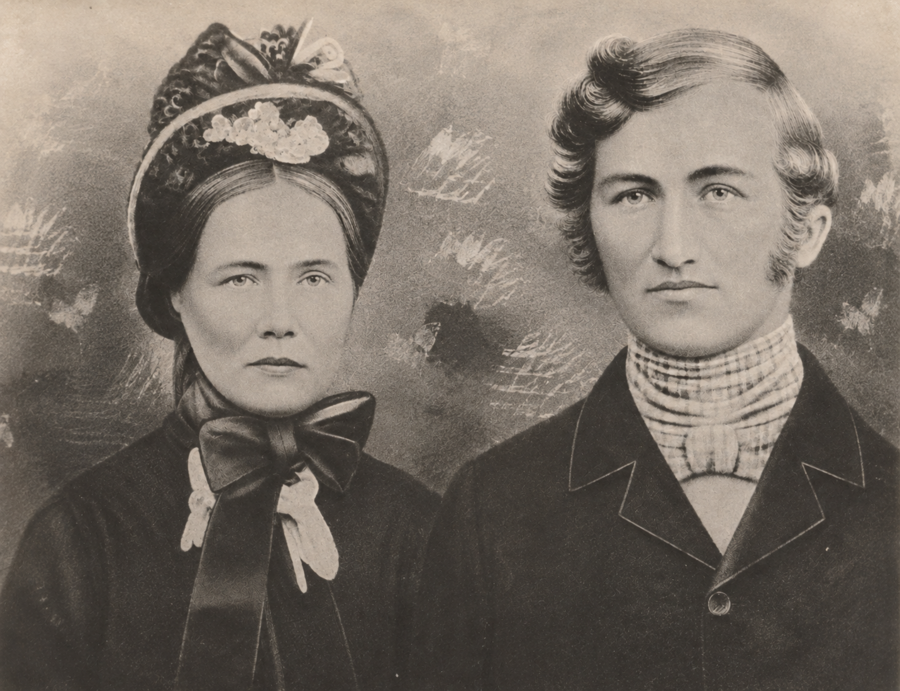
Charles and Minnie married on June 6, 1894, and welcomed seven children between 1895 and 1912: Robert Charles ‘Herald’, Wesley Vrooman, John Casey, Milton James, Flora May, Frank Parkinson, and Joseph Clare. Early in their marriage, the family lived on Joseph’s land at Concession 10, Lot 16.
In 1908, Charles purchased Lot 15 on Concession 7 in Oakwood, followed by the neighbouring southern half of Lot 14 from James Frise in 1912.
The Jenkins children attended Wylie School S.S. No. 9, also known as Peniel School, conveniently located across from the family farm. Alongside farming, Charles served eight years on Mariposa Township Council: as Councillor from 1913 to 1915, Deputy Reeve from 1916 to 1918, and Reeve in 1919 and 1920.
During his final year as Reeve, Charles played an important role in ensuring that the establishment of a war memorial in Little Britain was given priority. On Dec. 22, 1920, Charles and Colonel C. E. Weeks officially unveiled the memorial, honouring those who had served and sacrificed during the Great War. The first Remembrance Day service was held at the memorial on Nov. 11, 1921, beginning a tradition of remembrance that continues to this day.
The Great War also had a personal impact on the Jenkins family. Two of Charles and Minnie’s sons, Herald and Wesley, were drafted under the Military Service Act of 1917 and served. Following his return, Herald pursued a career in plumbing and electrical work before becoming a barber in his later years. Wesley followed in his father’s footsteps, farming in both Oakwood and Little Britain.
Following Charles’ death in 1936, the southern portion of Lot 14 passed to his middle son, John Casey, and remained in the family until 1999 when it was sold. Lot 15 passed to Charles’ fourth son, Milton, and eventually to Milton’s son, Ernest Hamill Jenkins.
All seven of Charles and Minnie’s children remained in the Oakwood and Little Britain area, establishing families and livelihoods of their own. Their daughter Flora married Robert “Stuart” Henderson, and during the early years of their marriage, the couple farmed the Henderson family property. In 1949, they moved to the Jenkins family farm to live with Minnie. Their son Frank initially worked as a truck inspector before securing employment with the Liquor Control Board in Little Britain, while Joseph pursued a career as a schoolteacher before turning to farming following his marriage.
Returning from the war, Wesley married Lucretia Campbell, daughter of August Campbell and Harriett Isabella Prouse, on Dec. 31, 1919. Shortly afterward, they left his family home and purchased a farm along Peniel Road, north of Oakwood.
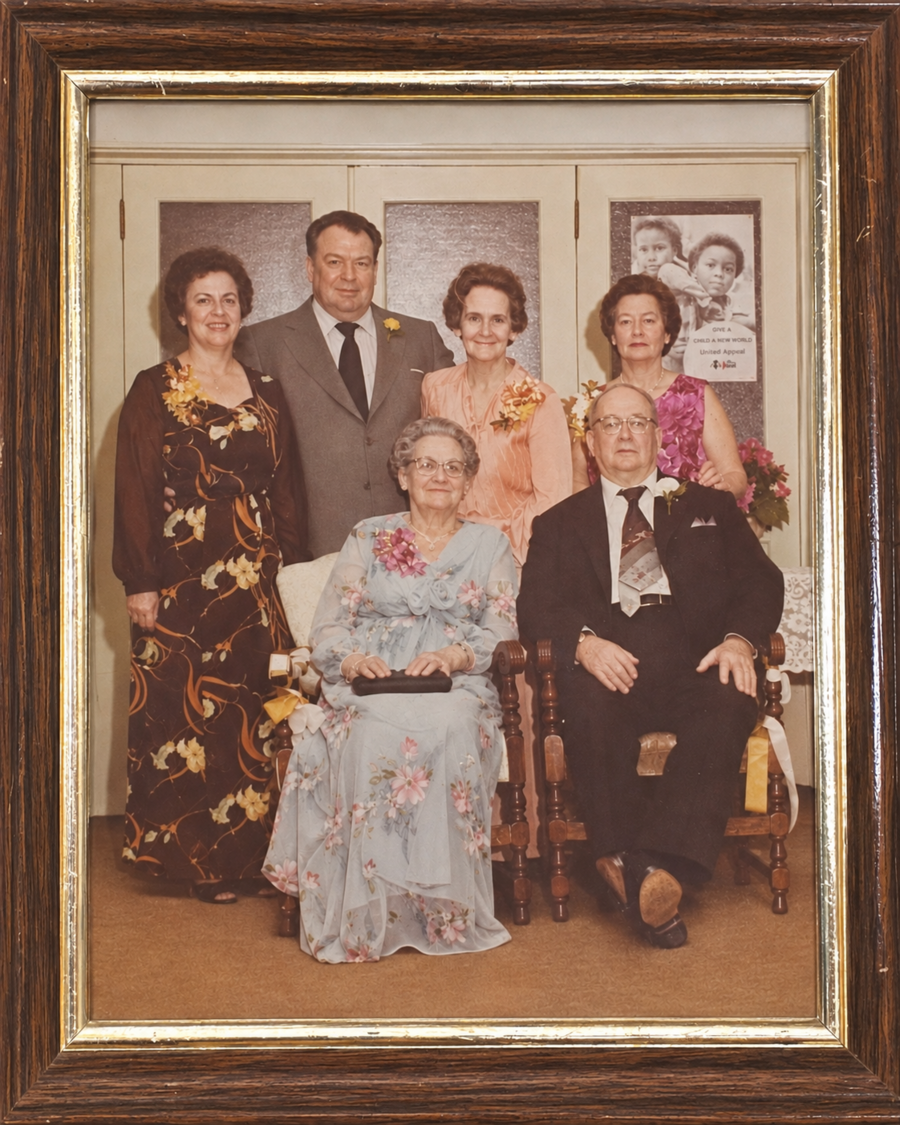
Wesley and Lucretia welcomed four children on the farm: Mary ‘Isabelle’, May Iona, William Charles Campbell, and Betty Grace Lucretia. Their son William (b. 1926) would become the father of Richard Jenkins, whose memories offer a personal glimpse into the family’s longstanding connection to Oakwood and Little Britain.
Richard recalls that his grandfather Wesley’s original farmhouse, affectionately called the “big house,” was destroyed by fire around the time the Old Quaker Meeting House, at Concession 12, Lot 21 in Mariposa, was demolished in 1929. When the farmhouse was rebuilt, salvaged wood from the Meeting House was incorporated into the front staircase railing, preserving a meaningful piece of community history within the family home.
In 1949, following their marriage in Lindsay, Richard’s parents, William and Jean, built a modest home across the farm laneway from William’s parents. Here, they raised three sons surrounded by farm life. In the mid-1980s, their house was moved closer to the Jenkins farmhouse.
Growing up, everyone was expected to help on the farm. Richard fondly remembers one of his first jobs was selling strawberries at the Oakwood Store for $1.75 an hour.
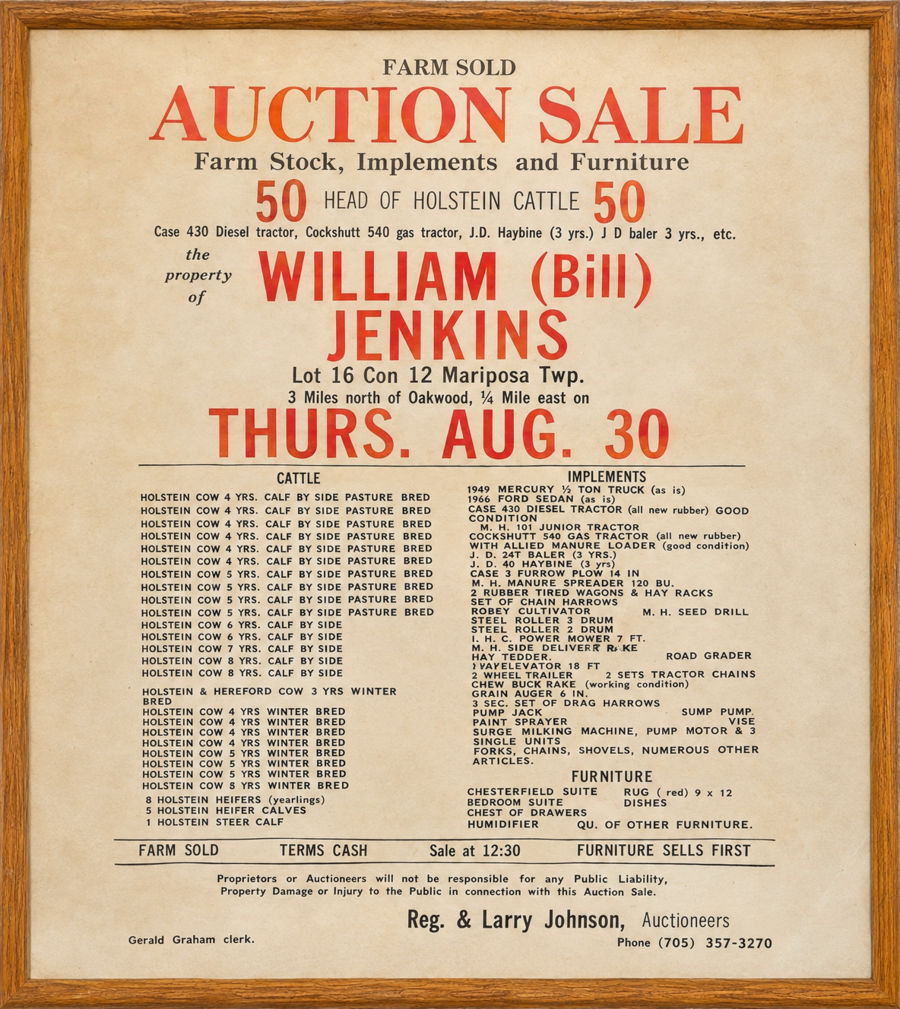
For Grades 1 to 5, Richard attended Brown School at Peniel and Eldon Roads, where Wesley served as caretaker and Mrs. Sherman Moore taught him from Grades 3 to 5. He attended Eden School for Grades 6 to 8, studying under Mrs. Prentice and Miss Nelson, before continuing to Lindsay Collegiate and Vocational Institute (LCVI).
When Wesley retired, the farm passed to William, while Wesley and Lucretia moved to Perry Street in Oakwood. Yet retirement hardly kept Wesley away. As Richard recalls, his grandfather “didn’t quite retire; he was always over at the house helping out with the farm.”
For years, the Jenkins farm raised pigs, chickens, and cattle, although operations gradually changed as Richard grew older. He recalls, “The chickens were first to go, then the pigs, and eventually only 30 dairy cows were left.”
In 1973, William sold the farm, ending another chapter in the Jenkins family’s farming history. William and Jean moved to Long Beach, Cameron, where they enjoyed living closer to the water. As Richard fondly recalled, “Mom always loved the water.”
Although the farm eventually passed into new hands, the Jenkins family’s connection to Oakwood and Little Britain remains woven into the communities’ history. From their beginnings in England to generations of farming, business, and public service in Kawartha Lakes, their story reflects the experiences of those who helped shape the region. Through Richard’s memories, these connections endure, offering a glimpse into a changing way of life and reminding us that, while farms, buildings, and communities may change, the stories of those who called them home remain an important part of Kawartha Lakes’ shared heritage.
Leave a Comment
Your email address will not be published. Comments are moderated.