
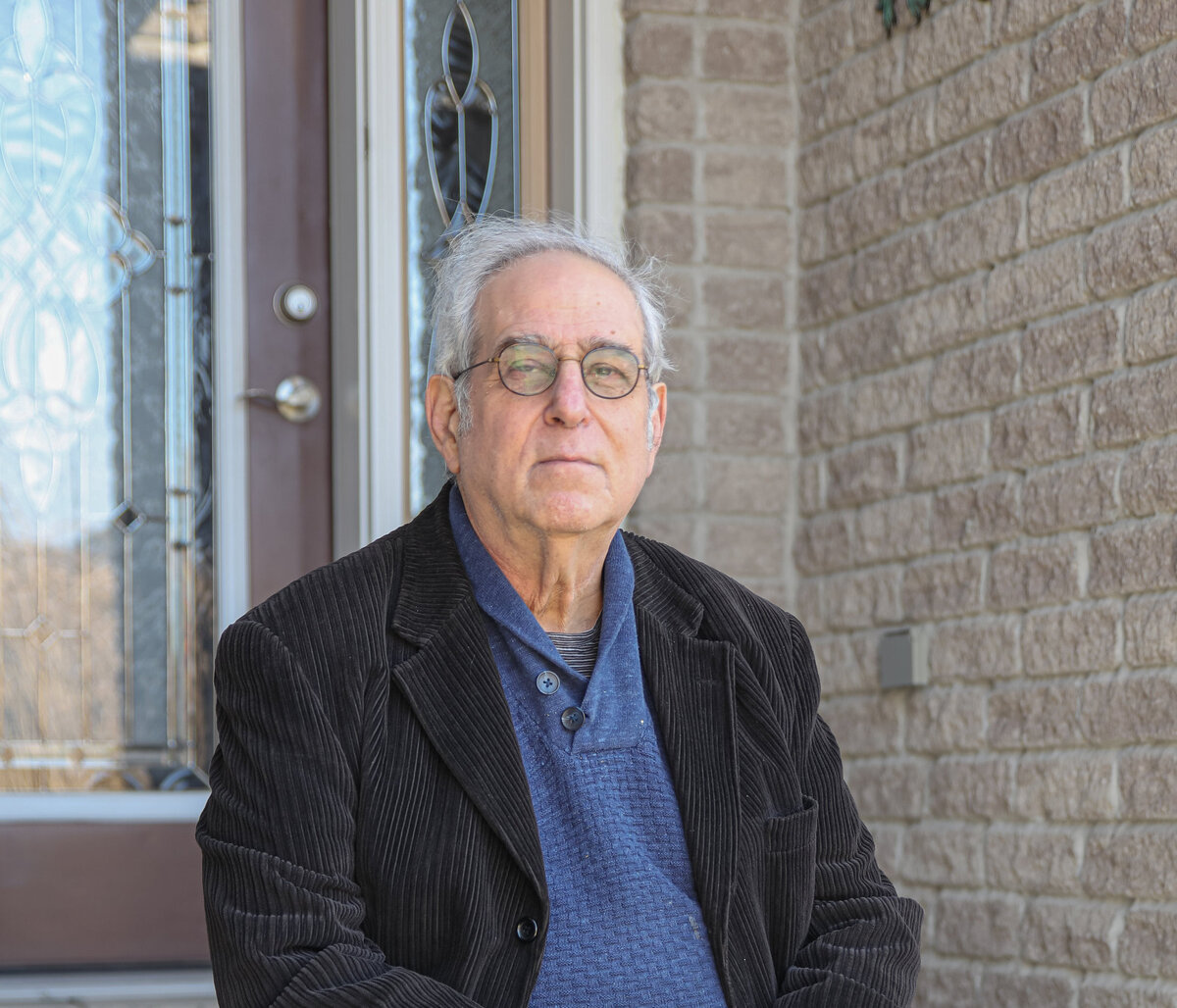
I love hearing a Brooklyn accent while sitting inside a Greek restaurant in downtown Lindsay, talking national and provincial politics with a Jewish professor. It just seems very Canadian somehow.
David Rapaport, 74, is an assistant professor in Trent University’s sociology department who has lived in Lindsay for the past two years. But he’s hardly feeling at home here yet – the isolation of COVID has made sure of that.
Rapaport and I meet at the Olympia Restaurant where we quickly fall into an animated discussion about a broad range of topics, but especially politics.
He has an easy manner about him, somehow both warm and cerebral at the same time.
The Olympia culinary magicians in the back kitchen (likely co-owner Costas Dedes) has concocted a delicious chicken rice soup, which is my order. Rapaport goes with the same and adds a Greek salad on the side.
Despite the Brooklyn accent, the relatively new Lindsay resident says he has been in Canada for a long time — about 54 years. He arrived in 1968 as “one of those draft dodgers.”
He grins. “You may have heard of us.”
He first went to Montreal, which seems like a glamourous choice for a young man from a large American city. He stayed for a few years and finished school at Sir George Williams University (Concordia University today.)
“I came to Toronto in ’71 and lived there right up until about two years ago.”
Like many people from the big city during the pandemic, “I wanted to get out of Toronto.”
Rapaport’s wife, who is Australian, is back home visiting family there when we meet, something she had not been able to do for a long time because of COVID.
They found their home in Lindsay’s east end not far from the Rotary Trail, just three days before the COVID curtain came down.
As an unabashed big city guy who has been active in the labour movement for years, Rapaport calls the neighbourhood “a bit suburban for my taste.”
“I grew up in Brooklyn. Still looking for the tree,” he says, a nod to to Betty Smith’s 1943 classic book, A Tree Grows in Brooklyn. It uses the Tree of Heaven as a metaphor to signify the plight of the poor immigrant class during the early years of the 20th century.
“I’m very urban. I never owned a car until I moved here to Lindsay. You know, to own a car in the city is just not thinking things through.”
Rapaport pointed out people can rent a car when needed in the big city “and you’re still miles ahead” financially compared to owning a car.
And speaking of transportation.
“Why is there no GO stop out of Lindsay? That’s insane. We should talk to the mayor. Laurie (MPP Laurie Scott) doesn’t seem to be able to move it forward.”
Rapaport is shocked that if he wants to go somewhere he has to drive almost to Highway 115 to get a GO bus. “We should do a campaign around that. I don’t get it. I’m sure there are a lot more cities smaller than Lindsay that have GO stops.”
Although he retired in 2009, he couldn’t make it stick. The itch to do more presented itself and so he began the doctoral program at the Canadian Studies department at Trent, completing it in 2015. Since then, he has taught in the departments of computer studies and political studies and is now in the sociology department. His main academic interests are labour, unions and technology.
However, his contract is done in August and he has a feeling it won’t be renewed because of funding restrictions.
“I’m getting too old,” anyway, he says. “The students are getting very demanding and their lives are really falling apart because of COVID. So many of them are working, too,” he says, which he acknowledges must create a lot of extra stress in their lives.
As lunch arrives, he goes back to the subject of local services and politics.
“Why is there only one blood lab in Lindsay? And it’s private! That’s not right.”
The professor says soon after he arrived, he tried talking to MP Jamie Schmale but they were never able to connect.
“But then I found out he supported the trucker convoy and I just didn’t want to talk to him. I couldn’t believe it — that my Member of Parliament would support that. It’s like supporting Jan. 6 in the United States.”
Schmale told the Advocate that his party supports the message the truckers took to Ottawa, and that he supports “the end of federal mandates too, as do the majority of Canadians. We believe that Trudeau put gasoline on a fire by calling the truckers names. Truckers felt that this was their chance to be heard by Ottawa.”
Rapaport did tell Schmale’s staff that he has been receiving the MP’s pamphlets and that he never sees the words climate change ever mentioned. “And that worries me.”
Digging into his food, he savours it for a few seconds. “This is good. So good.”
One of the professor’s greatest pet peeves are the words some people are throwing around with more alacrity these days.
“Language should be respected. Calling Trudeau a dictator? It’s out of control. They used to insult policy — now it’s just a visceral anger.”
Rapaport says when words aren’t respected it makes the future use of concepts impossible. “The words lose all meaning. Language matters — you should do an article on that.”
Then he turns his attention to Premier Doug Ford’s government. “Why is the province building highways? Buying up roads with our money? Giving back the licence tax? None of it makes sense.”
Rapaport jumps to personal leisure pursuits, speaking highly of the recreation centre in town. “It’s well-resourced and the staff is friendly and capable.”
He also mentions he just bought a kayak, given how close he lives to the Scugog River. “It’s a nice river and I can go fishing. It doesn’t even cost me anything anymore.”
I immediately assume Ford has given the fishing licence tax back, too. “No, it’s because I’m a senior,” he says with a laugh. “But that wouldn’t have surprised me.”



5 Comments