
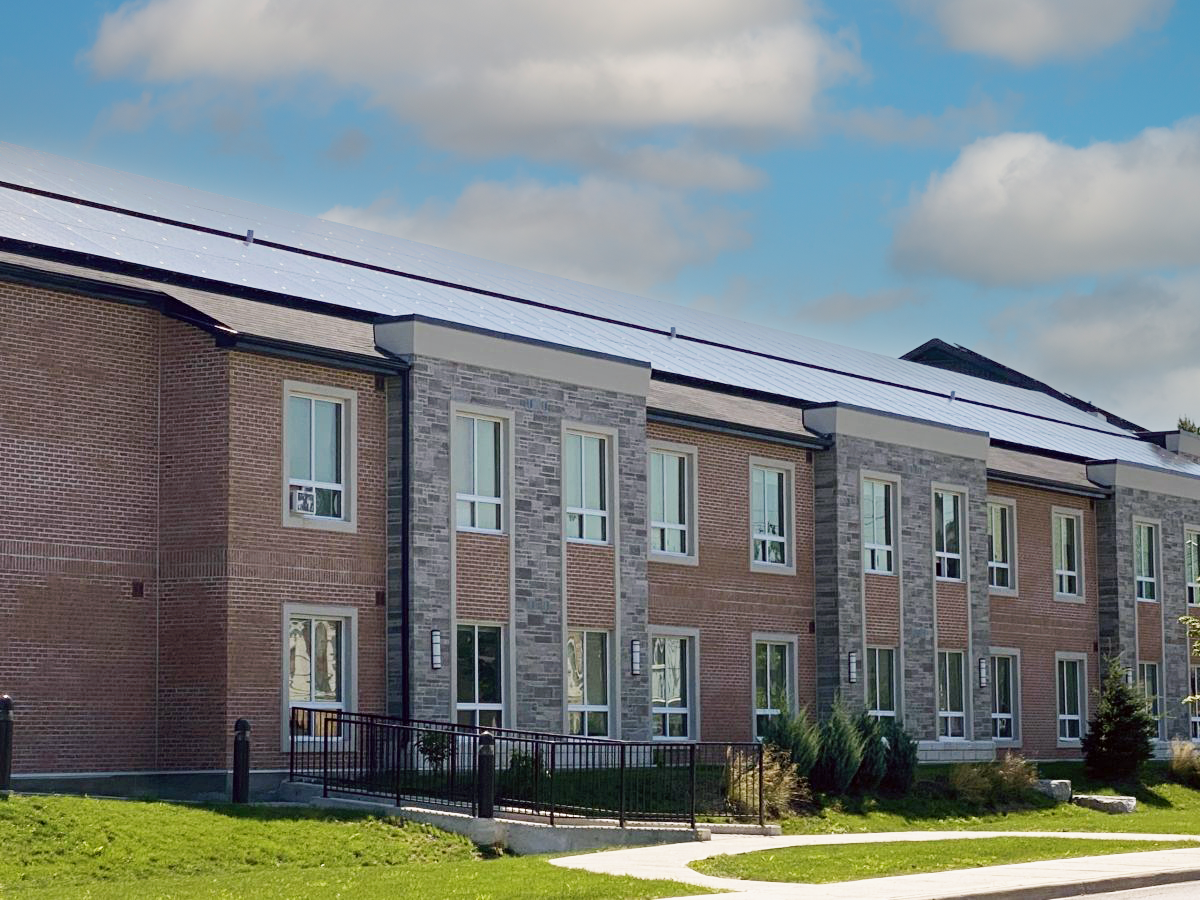
The low-slung institution where Lindsay meets Queen holds two worlds beneath its solar-panelled roof. Red brick, grey stone bays, four windows to each face, flora placed like punctuation, nothing in bloom – deliberately plain. A building meant not to be noticed. In one world, the city’s Human Services department, where the housing crisis keeps business hours. In the other, 24 apartments for those the city has called “at highest-risk of death if not housed.”
Lindsay’s settled story for this building is disorder, addiction and fear. The city’s records preserve a harder one: a building opened without the care later called essential. Declared a success 13 months before a shooting; changed once, now marked for a second change. The whole of it sits in the penumbra of the public record, unassembled and undeclared.
A cornerstone, poured late
At the 2017 groundbreaking, the mayor of the day said affordable housing “must be the cornerstone of any poverty reduction plan.” Benevolent ambition: shelter for the hardest to house. The budget was $8 million. By October 2017, council had approved $12.3 million, a rise one councillor called “the continuous bait and switch approach,” while the only shovels in the dirt were digging out contamination. The doors opened in June 2019, a year behind the promise.
What the City knew, and when
Three months after tenants moved in, council received a three-year Trent University study of the scattered-site program that preceded 68 Lindsay: two caseworkers supporting 45 people in whatever housing they had, with care following them. It worked. By then, the city had already housed two dozen of its most vulnerable residents at 68 Lindsay, people left destitute, many by drugs, under a budget that, the housing manager acknowledged in 2023, “meant that on-site intensive case management services could not be provided 24/7 as originally planned.”
Within months of opening, a mother petitioned to make it a rehab centre. She had lost her son to an overdose; her partner, living in the building, had relapsed. The city’s answer was “Housing First” doctrine, a roof before recovery. “It’s a ‘Housing First’ approach, not a program,” the director of human services said.
In December 2020, the city declared victory. “We know the model works,” its housing corporation’s head concluded. Guards arrived in 2021; still no night shift of care. The victory had scarcely a year in it.
The excuses were real: grants that ran short, then the pandemic, services closed, staff short, an eviction freeze holding dangerous tenancies. None of it explains seven years of nights without care. The city held a truer measure: the 2016 caseworker program it had been running, vindicated by its own study. It graded itself against the street instead, where any roof clears the bar.
Seven hundred police visits
In 2021, Lindsay’s police attended the address 716 times, nearly twice a day. Some visits, the chief said, were routine outreach. In October 2021, hundreds of locals filled the armoury, where a woman said that, her husband away, she wore a car alarm and carried a knife.
A tick before 10 at night on Jan. 30, 2022, police responded to a shooting at the building. The victim survived. “We responded immediately and arrested a guest of one of the residents,” the chief said. Weeks later the security firm quit, citing the law: “It’s the inability to restrict access ... because it is a residential building and covered by the landlord and tenant act.” The city had gathered people with the least protection under one roof and posted sentries at a gate the law held open.
A confession, received
In May 2022 an in-house report, Supportive Housing Update, went to council, whose entire response was “received,” municipal procedure at its most anodyne. Inside, the city’s own assessment: the supports were “insufficient,” the “congregation of those with the highest acuity” compounding it. The trenchant sentence: “Regardless of the implementation of a new housing model, those with the most complex challenges require a supportive housing model with 24/7 on-site clinical supports.” “Clinical” went undefined until city housing staff gave it shape: “low-barrier primary care, mental health and addiction supports, along with 24/7 housing support staff.”
The report attached no money to its prescription. The building half got built and paid for, nearly a million past the final approved budget at last report, the file closed, no single final cost we could find. The care half has never seen a budget line we can find. The only remainder was “ongoing advocacy,” the report’s phrase. Four years on we can find no request to the province to fund that round-the-clock care at 68 Lindsay, nor any answer. For tenants, that kind of advocacy is indistinguishable from none.
In spring 2022, report on the table, security gone, shooting on the record, the city hit reset. It hired new guards, changed the daytime caseworkers’ agency and, freeze now lifted, evicted tenants: for harm to others, for help refused and, in the city’s words, for needing “services that were not available.” Police visits fell by about a quarter, paramedic calls by more than half. The reset’s cost was recorded by the city itself: the changes, its housing staff wrote in 2023, “displaced several people who don’t currently have any available options for alternative housing or emergency shelter.” No record we found says where the displaced went.
The quiet rewrite
The rewrite began, unannounced, in 2022. That spring’s report proposed a new model for new tenants: “sub-letting,” renting until the lease became theirs, “participation in supports” the expectation. Provincial permission for the change came by fall. A 2023 news report, drawn from city housing officials, spelled it out: mandatory participation, with “a compliance component.” The building has run two-tier since, absorbing units as tenants turn over. The city calls the result “viable and low barrier.”
The building’s most consequential decision may be one line on slide 12 of a September 2025 budget deck, carried by no press release we can find: “68 Lindsay Street North – Service Delivery Model Change = Transitional Housing.” In city nomenclature, transitional housing means temporary housing. Weeks later, a council report answered what it means: tenants “ready to move on” are “taking up spaces.” A new priority moves existing tenants out, up the list into subsidized housing elsewhere. Who gets in has changed, too: the building erected for those likeliest to die without housing now takes, by design, people of somewhat lower acuity and needs. The care was never funded. The population was adjusted instead.
Remember the armoury: “There must be conditions around their stay there...,” the woman demanded. She got her wish. Within a year, participation became the price of a tenancy. The report that set the conditions categorized the care as essential. The conditions arrived. The care never did.
Lay the record end to end: around-the-clock case management planned, daytime hours delivered; 24/7 clinical supports prescribed “regardless” of the model; 24/7 support staff called for again in 2023. The name keeps changing; the conclusion never has. The people at 68 Lindsay need support at night. No version of it appears in any budget we could find. The city has said so since 2022, and each budget since has kept the lacuna where the care should be. What began as a mistake is now policy. Seven years, two models, three names for the care never given.
The question for October
The building known as 68 Lindsay is one structure. Around it, homelessness in the city’s service area is projected, without intervention, to more than triple in a decade. The city’s answer is a 10-year strategy, approved “in principle” last fall. “In principle” is what a council says when it likes the plan but has not seen the bill. The costing was due in June. The city’s latest report moves it to 2027, past the election, for “the newly elected Councils.” Same promise, bigger cheque.
The strategy’s financial recommendations land in the 2027 budget, the first the new mayor and council will write. We can find no forecast for the building’s change, nor a plan to pay for it. We have heard no candidate name this address.
The city’s report requires the night shift “regardless” of the model. The supports now run on extended daytime hours, seven days. Overnight, a security company holds the building. Four years after the city’s report prescribed clinical care around the clock, still the night belongs to a guard. In 2023 the province raised the city’s homelessness allocation by $1.1 million a year, money provincial rules let it spend on nursing and addictions support in supportive housing. The City sent $700,000 of that money to a twelve-bed hub on Peel Street. What no one has yet paid for is care through the night at 68 Lindsay. Sentries are not care.
Ask every candidate, before you vote:
The city has remade 68 Lindsay Street North once without saying so plainly, and more change is coming. What it has never done is staff the night with care. Will you? Name the year, and whose budget: the city’s or the province’s.
The next council will finish the change or stop it. Finishing it means conditions without the care the city called essential. When tenants fail, where do they go? Last time the door tightened, the city’s staff recorded the displaced. Stopping it restores nothing; both roads lead to the care. Funded, either model can defend itself. Unfunded, the town has seen the result: 2021, 700 police visits, a knife in a pocket. The outgoing mayor points at senior governments. Merely pointing names no year and no plan. The philosophies diverge. The empty night shift does not.
Little here was unknowable. Most was written down, and what the city knew it learned at its own door. This October, ask who means to keep a light on after closing. The city’s silence need not be ours.



5 Comments